- ITUS – Innovative Team for Unique Solutions
how to start a company
From History to Modern MVP StrategyStarting a company is not a new concept. People have been turning new ideas into business for centuries. If you are searching How to Start a Company in 2025, you will have to learn from history and use today’s technology.
1. History’s Greatest Lesson: The VOC Model
The Dutch East India Company (VOC), started in 1602, showed the world what 'Risk Sharing' and 'Public Investment' was.
Key Lesson: VOC focused on structure and long-term planning.
The Modern Twist: VOC started with big ships and thousands of people, but in today's digital era you don't need such
2. How to validate your idea? (The MVP Strategy)
Google’s top-ranking pages (like Forbes and Entrepreneur) have always placed emphasis on Market Validation. The biggest question when starting a company is not “How to start?”, but “Will people buy your product?”
The cheapest and most effective method is to create MVP (Minimum Viable Product).
What is MVP?: This is the basic version of your product which has only those features which help in solving the customer’s problem.
Validation in Low Budget: Without spending lakhs of rupees, create a simple landing page and test the content and marketing strategy using AI tools (like ChatGPT).
Feedback Loop: Take your MVP to real users and improve the product based on their feedback.
3. Old Problems, Modern Solutions (ITUS Company)
Just as it was difficult and expensive to maintain heavy ships in the VOC era, today’s startups fail due to “outdated infrastructure” and fragmented systems.
If you are serious about how to start a company the right way, then you have to keep your digital “ships” (IT Infrastructure) strong. This is where ITUS comes into play.
ITUS Advantage: We provide startups with modern tools and cloud systems that reduce their operational costs and increase efficiency.
ITUS – Innovative Team for Unique Solutions
How ITUS Company Solves Your Problems:
Repetitive Tasks & Inefficiency: The founder has less time when starting a startup. ITUS deploys automation frameworks that take over repetitive tasks, so your team can focus on high-value work.
Outdated Server Infrastructure:
It is difficult for a new company to install expensive servers. ITUS replaces them with secure and globally accessible cloud infrastructure that scales according to your budget.
Generic One-Size-Fits-All Tools:
Every startup is unique. ITUS delivers cloud solutions tailored to your business model that meet the exact needs of your industry. Security & Compliance Gaps: It is important to earn customer trust from day one. ITUS builds your systems with enterprise-grade encryption and GDPR compliance, so your data and brand are always safe.
ITUS Mission: We believe that technology should work with your business, not against it. We give startups the technological foundation they need to grow in the digital era.
Starting a Company with AI” – AI-Powered Workflows
In today's era, AI is not just an option, but your "Digital Co-founder".
The biggest difficulty when starting a business is time and money.
By using AI correctly,
you can avoid both of these and look like a professional brand from day one.
. Here are some practical ways you can make your startup “AI-First”:
Market Research & Planning (Dimaag Lagaiye, Waqt Nahi)Don’t depend only on basic Google search.
We pitched our idea to ChatGPT or Google Gemini and asked for a breakdown of our “Target Audience”
. Ask them “What would be the top 3 marketing strategies for my business?” This will get your hours of research work done in minutes.
Content & Copywriting
(Developing Brand Voice): Whether you want to write product descriptions for your website or send emails to customers,
AI makes your work easier. Don’t just “Write” ChatGPT, use it to set the “Tone” of your brand (ie: Friendly or Professional).
Then polish it using Grammarly AI so that your content becomes international level.
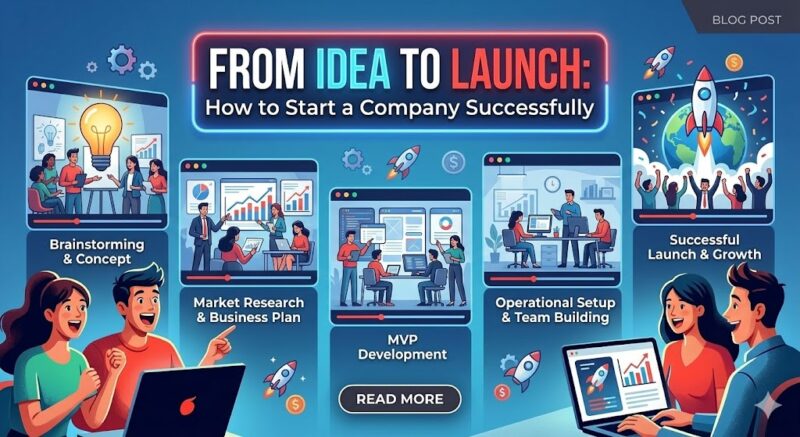
Step-by-Step Guide to Starting a Company – ITUS Perspective
-
- Shape the Solution – Define what makes your product stand out.
-
- Research the Market – Study competitors and customer demands.
-
- Write a Business Plan – Detail revenue streams, responsibilities, and tech stack.
-
- Choose a Legal Structure – Proprietorship, LLC, or Pvt Ltd.
-
- Register the Company – Build credibility and compliance.
-
- Secure Funding – Self-funding, angel investors, or grants.
-
- Build a Skilled Team – Hire people aligned with vision.
-
- Set Up Infrastructure – Replace old servers with ITUS cloud-first platforms.
-
- Develop an MVP – Test with a minimal viable product.
-
- Gather Feedback – Collect customer insights.
-
- Refine & Adapt – Iterate quickly using cloud agility.
-
- Build Your Brand – Website, SEO, consistent digital identity.
-
- Prioritize Customer Experience – CRM tools integrated with ITUS.
-
- Scale & Grow – Use ITUS scalable infrastructure to expand globally
A review or comparison of top business banking options.
| Bank | Account/Variant | Key Features | Minimum/Avg Balance / Free-limits* |
|---|---|---|---|
| HDFC Bank – Biz Pro+ / Biz Ultra+ etc | Free cash deposit up to ₹6 lakh/month or 10× AMB in Pro+; up to ₹25 lakh/month or 12× AMB in Ultra+. Also startup/current accounts with zero-non-maintenance for first few quarters. (HDFC Bank) | Good for growth businesses needing moderate to large cash deposit/withdrawal limits. | AMB/AQB varies by variant. Example for “Professionals Current Account”: AQB ₹10,000; non-maintenance ₹1,500/quarter. (HDFC Bank) |
| ICICI Bank – Smart Business / Startup Current Accounts | Zero minimum for first 6 months for some startup variants. Advanced digital/tech-support features. (mysa.io) | Good for tech-savvy/startup businesses. | After intro: e.g., QAB from ₹25,000 upward; free cash deposit up to large amounts depending on variant. (mysa.io) |
| Axis Bank – Business Current Accounts / Digital variants | Online opening, clear cash-deposit limits, good for small/medium businesses. (AxisBank) | Suitable for smaller businesses/SMEs. | Example: Monthly Avg Balance requirement: Metro/Urban ₹15,000; Semi-Urban/Rural ₹7,500. Free cash deposits up to ~₹1 lakh for certain variant. (AxisBank) |
| IDFC FIRST Bank – Multiple current-account variants | Transparent fee structure, business-friendly features, good for smaller to medium firms. (mysa.io) | Ideal for startups/SMEs looking for clarity and digital integration. | Example: 10K, 25K, 50K AMB variants: e.g., free cash deposit limit ₹2 lakh/month for ₹10K AMB variant. (mysa.io) |
| State Bank of India (SBI) – Regular Current Account | Nationwide reach, suitable for small businesses/traders. (Volopay) | Good for general SME/trader segments. | Example: Regular current account MAB (Monthly Avg Balance) around ₹5,000 in one variant. (State Bank of India) |
A comparison guide focusing on liability and tax implications.
| Business Structure | Owner Liability | Taxation Method | Best For |
|---|---|---|---|
| Sole Proprietorship | Unlimited personal liability. Owner’s personal assets can be used to cover business debts. | Taxed as personal income of the owner. No separate business tax. | Freelancers, small service providers, early-stage solo founders. |
| Partnership (General) | Unlimited liability shared among partners. Each partner is responsible for business debts. | Profits taxed as personal income of partners. | Small groups starting together with low initial risk. |
| Limited Liability Partnership (LLP) | Limited liability. Partners are protected from each other’s mistakes. | Taxed as a separate legal entity, but more tax-friendly than companies in many regions. | Professional firms like IT services, consulting, and agencies. |
| Private Limited Company (Pvt Ltd) | Limited liability. Personal assets are protected. | Corporate tax applies. Dividends may be taxed separately. | Startups seeking funding, scalability, and credibility. |
| Limited Liability Company (LLC) (International equivalent) | Members have limited liability. | Flexible taxation. Can be taxed as a sole prop, partnership, or corporation. | Small to mid-sized businesses wanting liability protection with flexible tax options. |
| Corporation / Public Company | Strongest liability protection. Owners/shareholders not personally liable. | Corporate tax on profits. Shareholders taxed on dividends. | Large-scale operations, investors, IPO-ready companies. |
Top IT Service Companies
-
- Accenture : Expertise in consulting and digital transformation.
-
- Infosys : Strong learning culture, focus on cloud & AI.
-
- Wipro : Cloud migration, automation, and cybersecurity.
-
- HCL Technologies : Digital engineering, enterprise IT.
Why ITUS Company Stands Out:
When you start a company today, the smartest move is to build with modern tools instead of outdated systems. Unlike the giant IT firms that still rely on legacy frameworks, ITUS company is lean, agile, and fully cloud-first from the ground up. While larger organizations spend years adapting old structures, ITUS creates modern infrastructures with seamless integration, strong security, and fast deployment.
For new entrepreneurs searching How to Start a Company, ITUS becomes a live example of what modern building looks like. Anyone trying to understand How to Start a Company can see how ITUS avoids the slow, heavy paths of legacy technology. And for founders who truly want to learn to Start a Company, ITUS shows how choosing cloud-first systems lets you grow faster, stay secure, and build for the future from day one.
How to Start a Company, ITUS becomes a living example of how a future-ready business can be built from day one, using technology that supports growth instead of slowing it down.
A guide explaining the difference between essential finance roles.
| Finance Role | Main Responsibility | Focus Area | Skills Required | When a Company Needs This Role |
|---|---|---|---|---|
| Bookkeeper | Records daily financial transactions (sales, expenses, payments). | Accuracy, day-to-day entries. | Basic accounting, software tools (Tally, Zoho, QuickBooks). | From day one when business starts handling money. |
| Accountant | Prepares financial statements, manages taxes, ensures compliance. | Monthly/annual reports, tax filings. | Accounting standards, GST/IT knowledge, analysis. | When you need compliant books, tax returns, and periodic reporting. |
| Financial Analyst | Studies financial data to predict trends and support decisions. | Forecasting, budgeting, performance analysis. | Data analysis, Excel/BI tools, financial modeling. | When the company begins planning growth, budgets, and investments. |
| Finance Manager | Oversees budgets, controls spending, manages cash flow. | Business performance, cost management. | Leadership, forecasting, planning, negotiation. | When the team grows and needs structured financial control. |
| Controller | Ensures precise financial reporting and internal controls. | Compliance, audits, high-accuracy reports. | Advanced accounting, risk management, auditing. | When revenue grows and strict financial discipline becomes essential. |
| CFO (Chief Financial Officer) | Leads the entire financial strategy: fundraising, long-term planning, investor relations. | Strategy, capital structure, valuation. | Leadership, finance architecture, fundraising, forecasting. | When scaling, raising investment, or targeting long-term strategy. |
| Treasurer | Manages the company’s money, investments, banking, and liquidity. | Cash flow, reserves, financial risk. | Risk management, banking relationships. | When the company has large cash movements or investment decisions. |
| Internal Auditor | Reviews company processes to prevent fraud and ensure compliance. | Risk control, internal checks. | Audit, compliance, investigative analysis. | When the company becomes large enough to require internal checks. |
Common Points in the IT Industry
-
-
- Skill Stagnation : Solved by TCS, Accenture, Infosys.
-
- Lack of Leadership Guidance : Addressed by Infosys.
-
- Career Plateau : Accenture combats with cross-domain mobility.
-
- Limited Exposure to Emerging Tech : Infosys & Accenture emphasize AI and cloud.
-
- But for SMBs and startups : ITUS company offers a direct, cost-effective cloud-first approach.
Compact Comparison Chart
Why Trust ITUS Company?
| Investor Type | Money Size | Speed | Equity Taken | Best Stage |
|---|---|---|---|---|
| Bootstrap | Small | Fast | None | Idea/MVP |
| Friends & Family | Small–Medium | Very Fast | Optional | Prototype |
| Angel Investors | Medium | Fast | Yes | MVP/Early Traction |
| Angel Networks | Medium | Medium | Yes | MVP+ |
| Micro VCs | Medium | Medium | Yes | Early Growth |
| Seed VCs | High | Slow | Yes | Early Revenue |
| Accelerators | Small | Medium | Yes | MVP |
| Govt Grants | Small–Medium | Slow | None | Innovation/R&D |
| Corporate Investors | High | Slow | Yes/No | Scaling |
Anyone trying to understand How to Start a Company can see how cloud-first tools remove limits and speed up growth. And for founders searching for a practical guide on How to Start a Company, ITUS proves that choosing smart technology instead of old systems helps startups grow faster, stay secure, and focus on what truly matters building a strong, future-ready business.
Our cloud-first philosophy delivers:
-
-
- High Security : Enterprise-grade encryption, GDPR compliance, zero-trust architecture.
-
- Seamless Integration : Tools and platforms that work across teams.
-
- Scalability : Infrastructure that grows with your company.
-
- Reliability : Future-ready systems with reduced downtime.
-
- Transparency : No paid endorsements, only results backed by client outcomes.
Final Thoughts
From the VOC in 1602 to ITUS today, the idea of a company has always been about overcoming barriers whether in trade routes, IT infrastructure, or understanding complex digital spaces like What is Dark Web. For anyone exploring how to start a company, the evolution from VOC to ITUS offers powerful lessons in innovation and adaptability. The VOC introduced governance and investment systems that shaped the modern economy.
Starting a company today means building with the future in mind. The business world has evolved from the early days of the VOC to a fast-moving, technology-driven landscape. Today, ITUS company modernizes this legacy by solving the pain points of outdated infrastructure and enabling businesses to thrive with cloud-first solutions. Shark Mondo, a digital marketing agency, highlights how modern companies like ITUS are driving digital transformation across industries.
For entrepreneurs searching How to Start a Company, ITUS stands as a real-world example of innovation in action. Anyone trying to understand How to Start a Company can look at how ITUS builds secure, scalable systems from day one. The journey of companies is a story of evolution, and for those wanting a clear road map on How to Start a Company, ITUS company leads the way with innovation, scalability, and resilience helping new founders build smarter, faster, and stronger from day one.
FAQs
1. How do I start a company in India?
To start a company, you need a business idea, market research, a clear business plan, the right legal structure, company registration, funding, a skilled team, and modern IT infrastructure. For anyone searching How to Start a Company, cloud-first tools like ITUS can help set up a secure and scalable system from day one.
2. Who established the first company in the world?
The first publicly listed company was the Dutch East India Company (VOC), founded in 1602. It introduced shares, voting rights, and corporate governance, shaping how modern companies operate today. For anyone exploring How to Start a Company, the VOC’s legacy offers powerful lessons in structure, investment, and long-term growth.
3. Why is IT infrastructure important for new companies?
Strong IT infrastructure ensures smooth operations, better security, faster collaboration, and lower maintenance costs. For anyone learning How to Start a Company, ITUS provides cloud-first solutions that help startups grow without technical limitations.
4. Which business banking account is best for startups?
HDFC, ICICI, Axis, IDFC FIRST, and SBI offer strong current accounts. The best choice depends on your cash deposit limits, minimum balance, digital features, and business size. ICICI and IDFC are popular for startups due to their tech-friendly features.
5. What is the best business structure for new entrepreneurs?
For solo founders, a Sole Proprietorship works. For risk protection, choose LLP or Pvt Ltd. If you want investors or plan to scale, Pvt Ltd is the most preferred structure.
Conclusion
Starting a company is not just about launching a business. It’s about choosing the right tools, the right structure, and the right direction from day one. From the first-ever VOC model to today’s cloud-first world, everything shows that the companies who adapt are the ones who grow.
ITUS follows the same path: modern, fast, and built for today’s digital challenges. If you want to start strong, scale fast, and avoid old-school tech headaches, ITUS gives you the right foundation to grow your business with confidence.
कंपनी शुरू करना हर उद्यमी का पहला बड़ा कदम होता है। कंपनी की नींव सही विचार, बाज़ार शोध, स्पष्ट बिजनेस प्लान और सही टेक्नोलॉजी ढांचे पर टिकती है। इतिहास बताता है कि पहली कंपनी Dutch East India Company थी, जिसने शेयर और कॉर्पोरेट सिस्टम की शुरुआत की। आज ITUS कंपनी यही आधुनिक रूप में करती है। ITUS क्लाउड-फर्स्ट, सुरक्षित और स्केलेबल समाधान देकर व्यवसायों को पुरानी तकनीक से बाहर निकालती है। चाहे स्टार्टअप हो या बड़ा संगठन, सही IT इंफ्रास्ट्रक्चर, फाइनेंस रोल समझ, बैंकिंग विकल्प, और कानूनी संरचना चुनना सफलता की कुंजी