Table of Contents
AI STARTUP IN INDIA
INTRODUCTION
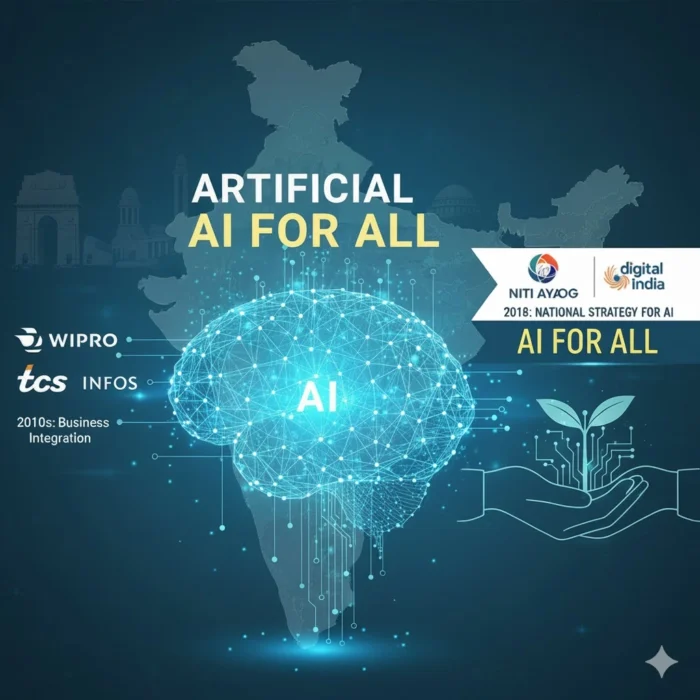
In India, artificial intelligence (AI) is expanding quickly. AI is playing a crucial role and evolving quickly, becoming important in a variety of industries, including business, healthcare, and education. AI gained popularity in India about 2010 when major IT firms like WIPRO, TCS, and INFOSYS began utilising AI for commercial solutions.
Innovation and real-world applications of AI across industries have been further boosted by the growth of AI startups in India. The government primarily concentrated on AI in 2018 after NITI AAYOG published the “AI FOR ALL” national plan for AI. The government is also encouraging the development of AI in India; programs like NITI Aayog and Digital India have been essential in fortifying the ecosystem and laying a solid basis for AI startups in India.
INDIA’S VISION “AI FOR ALL”
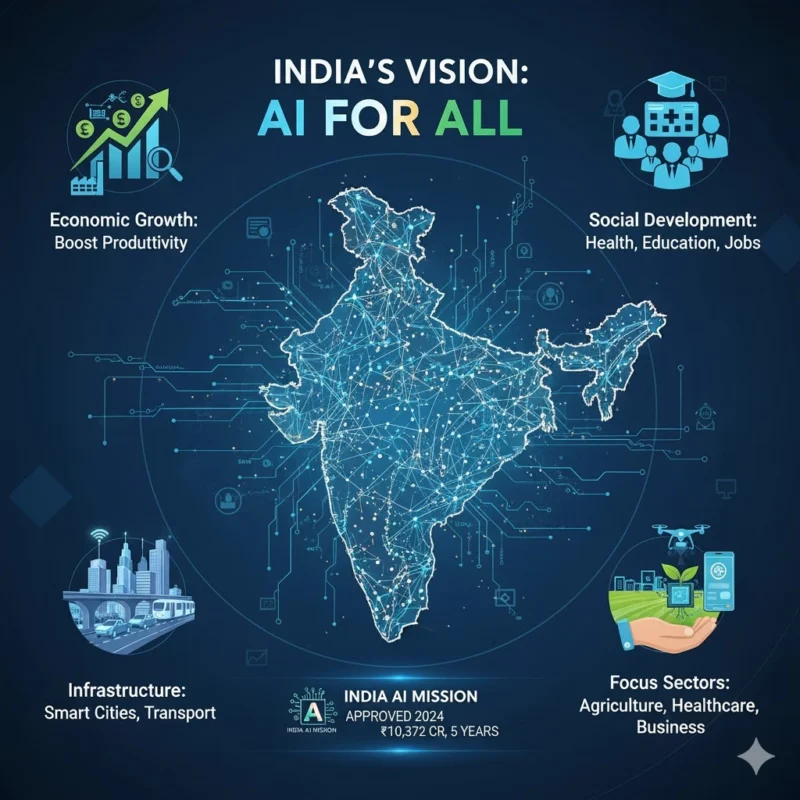
In India, AI has grown to be an effective instrument for a variety of areas, including healthcare and education. By increasing productivity and automating several processes, it has drastically decreased the need for human labour. The idea of AI FOR ALL has acquired significant traction due to India’s sizable population and quick growth in the digital economy. In order to make this vision a reality, spur innovation, and develop solutions that benefit society as a whole, the emergence of AI startups in India is essential. India’s main goal is to use inclusive and responsible development of AI to benefit all facets of society.
The 2025 Indian AI Landscape at a Glance
| Feature | Details |
| Projected Market Size | $17 Billion by 2027 (NASSCOM/BCG) |
| Top Unicorns | Krutrim AI, Fractal Analytics, Uniphore, Glance |
| Key Funding Trend | Shift from Generative Apps to Infrastructure (GPUs & Cloud) |
| Government Support | 38,000+ GPUs made available via IndiaAI Mission |
1. The Pioneers: India’s AI Unicorns & Giants
These companies represent the bedrock of the Indian AI ecosystem, boasting valuations over $1 billion and global footprints.
- Krutrim AI (The First AI Unicorn): Founded by Bhavish Aggarwal (Ola), Krutrim is India’s answer to ChatGPT.
- Key Achievement: Launched Krutrim-2 in early 2025, a 12-billion-parameter model optimized for 22+ Indian languages.
- Focus: Sovereign AI, Indic LLMs, and AI-optimized hardware.
- Fractal Analytics: One of the oldest and most respected AI firms.
- Focus: Decision intelligence for Fortune 500 companies. Their healthcare wing, Qure.ai, is a global leader in AI-based radiology.
- Uniphore: A powerhouse in Conversational AI.
- Focus: Emotion AI and speech recognition for enterprise customer service.
2. The Sovereign AI Wave: Building India’s LLMs
The biggest missing piece in previous years was foundational models. These startups are now filling that gap:
- Sarvam AI: Backed by Lightspeed and Peak XV, Sarvam focuses on “small, efficient models” for Indian use cases. Their Bulbul V3 is a leading voice AI for regional dialects.
- Neysa AI: Focusing on the “Infrastructure” layer, Neysa provides AI cloud services and sovereign GPU clusters to help other startups scale without relying on global tech giants.
- CoRover.ai: Known for BharatGPT, the first indigenous conversational AI used by government agencies and Indian Railways.
key goods of india ‘s vision
1.economic growth
AI is the one most important technology for developing india . AI is a powerful tool which is help to boost productivity and create new opportunities for achieve the economic growth. AI is not just a tool; it is a catalyst for India’s GDP.
New Revenue Streams: AI is creating new markets in data labeling, model fine-tuning, and AI-as-a-Service (AIaaS), making India a “Back-office for the AI world.”
Productivity Boost: AI automation allows Indian MSMEs (Micro, Small, and Medium Enterprises) to compete globally by reducing operational costs by up to 30%.
The Funding Influx: In 2024-25, Indian AI startups raised billions in venture capital, signaling global confidence in India’s tech talent.
2.social development
AI is not only for economic growth it also help for social development . AI helps to improve the lifestyle of people. AI is also for crack challenges relate like help health,education and its also help to make job opportunities. AI helps in reaching the last mile of Indian society.
Crisis Management: AI models are now used for flood prediction and disaster response in climate-vulnerable states like Odisha and Kerala.
Language Barrier Removal: Startups like Bhashini and Sarvam AI are using translation models to provide government services and banking in regional dialects, empowering non-English speakers.
Job Creation: While some roles are automated, AI is creating high-demand jobs in data science, prompt engineering, and AI ethics.
3.infrastructure
Infrastructure is all about roads, bridges, transport, electricity, and smart cities. AI is playing a very important role in making infrastructure smarter and safer. The rise of AI startup in India has accelerated the use of advanced technologies in urban planning and smart city development. AI is now being used in smart cities to reduce traffic, minimize pollution, and improve public safety. It is also being applied in the transport sector from buses and trucks to metro systems ensuring smoother, more efficient, and safer travel experiences for citizens. AI is the “brain” behind India’s modern infrastructure.
Safe Public Transport: AI-enabled CCTV in Metros and buses ensures female safety through real-time facial recognition and anomaly detection (e.g., detecting a crowd or an unattended bag).
Smart Traffic Systems: AI-powered cameras in cities like Bengaluru and Delhi use real-time computer vision to reduce congestion and detect traffic violations automatically.
Energy Efficiency: Smart grids use AI to predict electricity demand, reducing power wastage and helping India reach its “Net Zero” carbon goals.
Government vision for AI
Government focus to make AI innovation worldwide and use for growth of the counties . india government set a strong vision for AI improve the growth and make opportunities for all the citizens. The Indian government has moved from “Planning” to “Execution.”
Unified Health Interface (UHI): Similar to UPI, AI is being integrated into health records to provide instant AI-based preliminary diagnosis for citizens via the Ayushman Bharat digital mission.
IndiaAI Mission: With a budget of over ₹10,000 Crore, the government is building an AI supercomputing infrastructure to provide “Compute Power” to startups at low costs.
Focus sectors
When the government launched NITI Aayog in 2018, its focus was on agriculture, healthcare, education, and business. These focus areas are directly connected with economic growth and social development. Along with this vision, the emergence of AI startup in India has strengthened these sectors by providing innovative solutions, improving efficiency, and supporting the government’s mission to integrate AI-driven technologies for inclusive national progress.
- AI promotes many apps for healthcare
- AI helps to improve the productivity and reduce the risk of damage crops.
- AI very useful platform for students and its improve the learning and skills development.
Healthcare: Precision & Speed
- Early Diagnosis: AI apps are being used in rural clinics to detect Tuberculosis and Diabetic Retinopathy from simple X-rays and eye scans.
- Telemedicine: AI-powered chatbots provide 24/7 medical advice in local languages, reducing the burden on city hospitals.
Agriculture: From Seeds to Harvest
- Precision Farming: AI helps farmers determine the exact amount of water and fertilizer needed, reducing wastage by 20%.
- Market Price Prediction: AI models analyze global supply chains to tell Indian farmers the best time to sell their crops to get the maximum price.
Education: Personalized Learning for Every Child
- Adaptive Learning: Platforms are using AI to identify a student’s weak areas and provide customized practice tests.
- Skill Development: AI is being used in vocational training to teach new-age skills to the Indian youth, aligning them with the “Skill India” mission.
India ai mission
In India, AI is now transforming every industry. In 2018, the government established NITI Aayog with an emphasis on business, healthcare, education, and agriculture. The nation’s social and economic development are closely related to these focus areas. These industries have benefited from the growth of AI startups in India, which have introduced innovation, automation, and data-driven solutions that raise productivity and advance sustainable development nationwide.
Challenges and strategies for AI
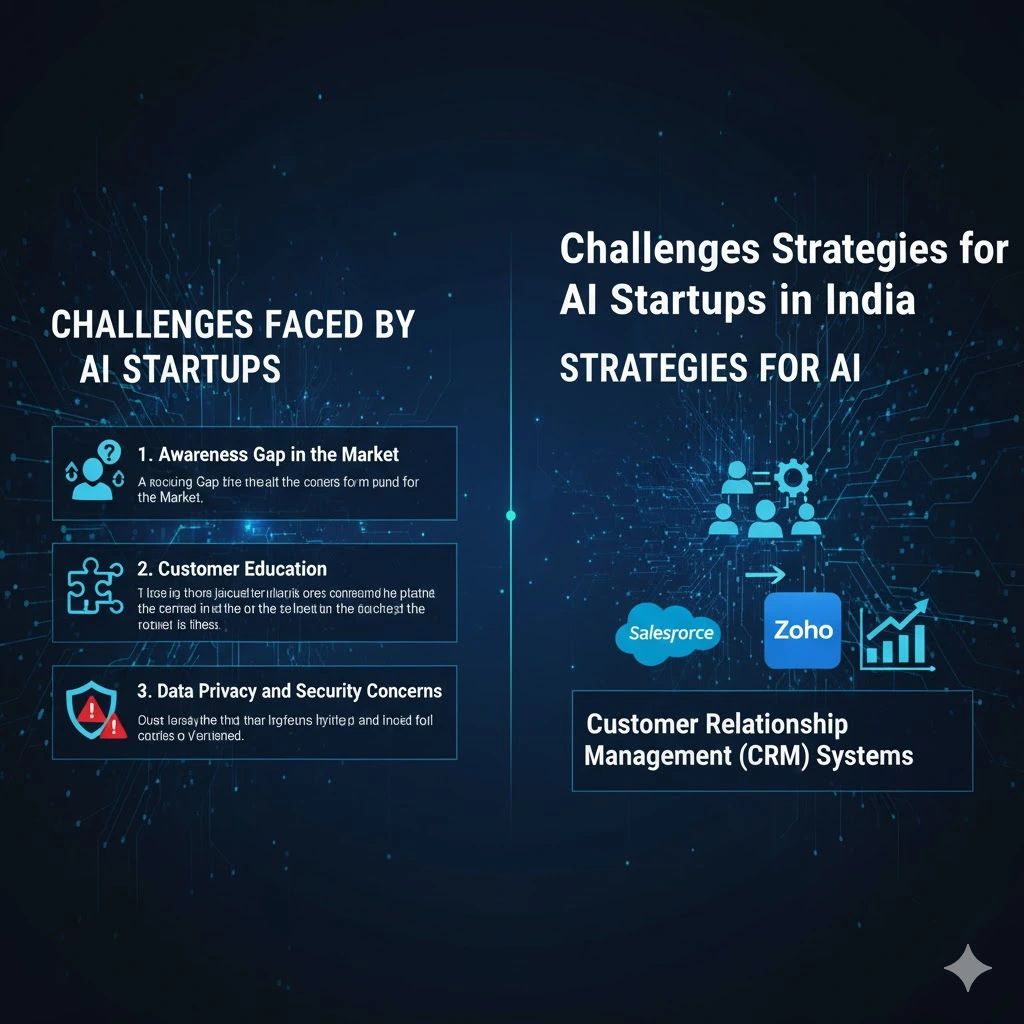
challenges faced by AI startup
1. Awareness Gap in the Market
Even though AI has a lot of potential, there is a big knowledge gap in India, especially in smaller towns and rural areas. Adoption is significantly hampered by the fact that many companies and end users are ignorant of how AI may help them. The expansion of AI startups in India might be crucial for raising awareness and showcasing practical uses of AI. Webinars, online courses, and tutorials are examples of educational marketing that can assist close this gap and promote broader use in all industries.
2. Customer Education
As AI technologies can be complex, educating the customer about the product’s value proposition is essential. AI startup in India can leverage content marketing, particularly through explainer videos, blogs, and customer testimonials, to demystify the technology and make it more relatable to businesses and end-users.
3. Data Privacy and Security Concerns
AI startups in India that rely significantly on data for machine learning algorithms have difficulties due to the country’s increasing emphasis on data privacy laws, such as the Personal Data Protection Bill. These firms must reassure their clients that their data is safe, and clear data handling guidelines should be successfully disseminated through digital platforms.
strategies for AI
Customer Relationship Management (CRM) Systems
AI startups can benefit from CRM platforms like Salesforce or Zoho to track customer interactions, manage sales pipelines, and ensure high levels of customer satisfaction through personalized communications.
Stay Lean & Iterate Fast
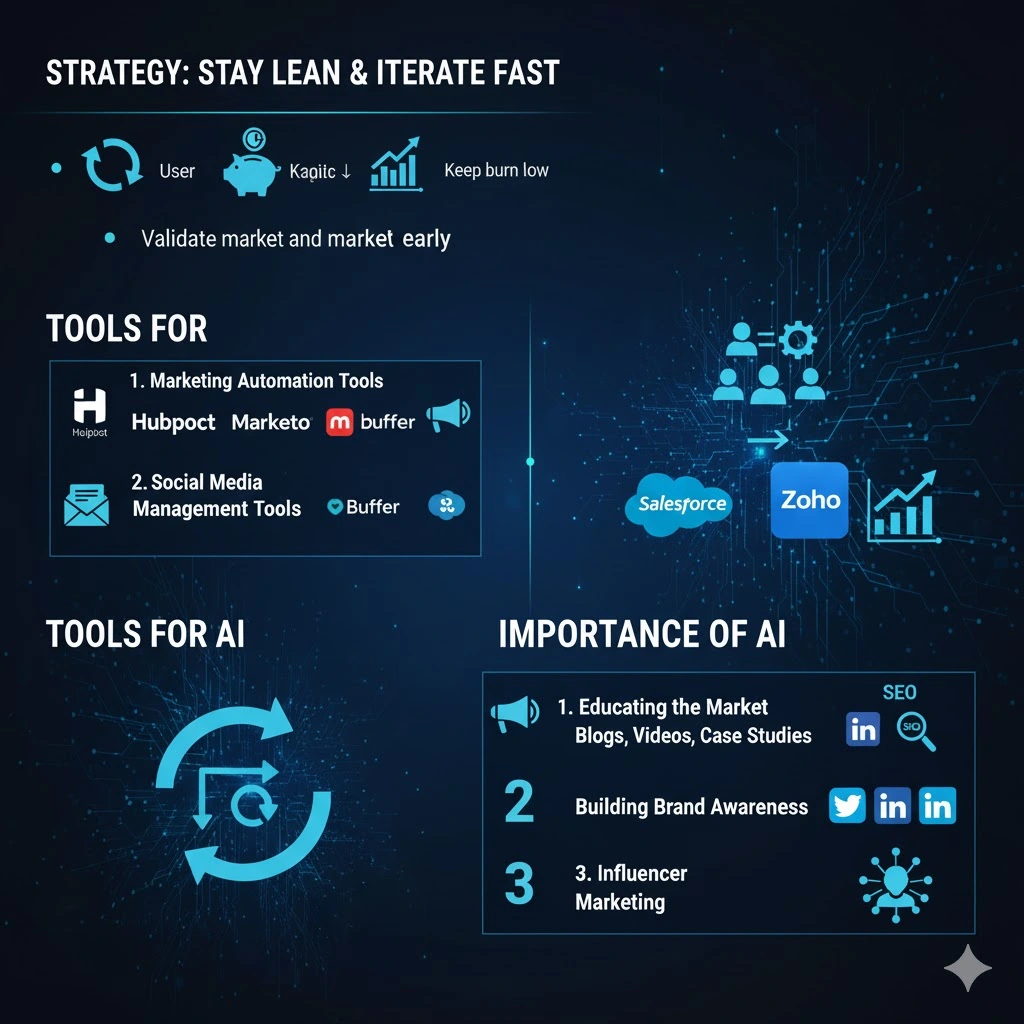
Strategy:
- Focus on user feedback and fast iteration.
- Keep burn low especially during R&D-heavy early phases.
- Validate market early before scaling tech.
tools for AI
1. Marketing Automation Tools
AI-powered marketing automation tools like HubSpot and Marketo can help AI startup in India automate email campaigns, lead nurturing, and customer segmentation. Automation not only saves time but also enhances personalization and efficiency, enabling startups to scale their marketing efforts effectively.
2. Social Media Management Tools
Platforms like Hootsuite and Buffer allow AI startups to manage multiple social media accounts from a single dashboard, schedule posts, and analyze engagement metrics to refine their strategy.
Why These Tools are Important
As; customers now demand a “Hyper-Personalized Experience.” By integrating these AI tools into your workflow, your startup can achieve two key competitive advantages:
1. Drastic Reduction in Manual Workload
Modern AI tools can automate up to 70% of repetitive administrative and marketing tasks. By offloading email sequencing, data entry, and basic customer queries to AI, your core team can shift their focus back to high-value Research & Development (R&D) and product innovation.
2. Transition to Data-Driven Decision Making
Moving beyond “gut feeling” or guesswork, AI-backed analytics provide real-time insights into customer behavior. These tools allow you to refine your strategy based on hard data predicting which content will perform best and identifying which leads are most likely to convert before you even spend a rupee on advertising.
importance of AI
1. Educating the Market
AI technologies can be complex, and many businesses and consumers are still unfamiliar with their potential applications. Digital marketing allows AI startup in India to educate their audience through content marketing. Through blogs, white papers, case studies, and explainer videos, AI startup in India can break down complex concepts and showcase how their products solve real-world problems.
2. Building Brand Awareness
One of the biggest challenges for AI startups in India is creating awareness about their product or service in a market where understanding of AI is still in its nascent stages. Digital marketing helps AI startups establish their presence and communicate the value of their technology to potential customers.
AI startup in India can leverage platforms like Google Ads, Facebook Ads, and LinkedIn Ads to reach a highly targeted audience based on their interests, demographics, and professional background. Search engine optimization (SEO) also plays a pivotal role in improving online visibility and attracting potential customers.
3. Influencer Marketing
In the rapidly evolving world of AI, influencer marketing can be an effective strategy for promoting an AI startup in India’s product. Many thought leaders in the AI space have large followings across platforms such as Twitter and LinkedIn, and partnering with them can give your startup credibility and a broader reach. Influencers can showcase the impact of your AI product through interviews, reviews, or by simply discussing your technology.
What to expect in next decade:
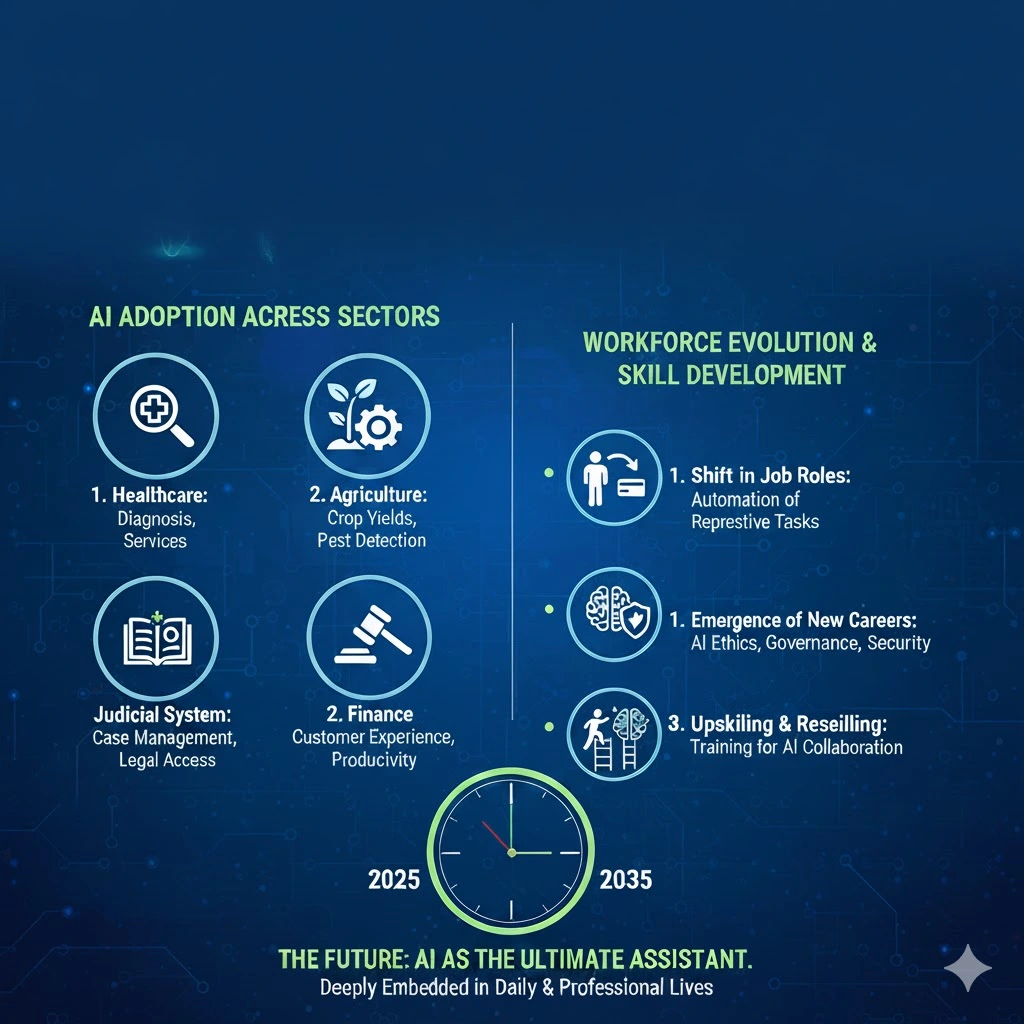
AI is still in its infancy in India, but it is increasingly being used for daily activities. By the decade’s end, this powerful tool would become commonplace for everyone. The growth of AI startup in India is expected to play a key role in making India a global AI powerhouse, boosting the economy significantly and transforming industries like agriculture, healthcare, and finance through advanced automation and personalized solutions.
In India AI Adoption Across Sectors:-
1. Healthcare: AI is being used for malaria diagnosis and improving healthcare services.
2. Agriculture: AI helps optimize crop yields, manage irrigation, and detect pests and diseases.
3. Finance: AI improves customer experiences and enhances productivity.
4. Judicial System: AI is being integrated to organise cases and provide rapid access to legal reference.
Workforce Evolution & Skill Development:-
1. Shift in Job Roles: Repetitive tasks will be automated, but human roles will evolve into managing, refining, and overseeing AI systems.
2. Emergence of New Careers: New positions in AI ethics, governance, AI model monitoring, security, and human-in-the-loop systems will be created.
3. Upskilling & Reskilling: A significant increase in demand for AI-skilled professionals is anticipated, necessitating a focus on training and upskilling the workforce to collaborate with AI technologies.
What is the future of AI in the next 10 years?
The Next 10 Times( 2025 – 2035) AI as the Ultimate Assistant. In the coming decade, AI’ll come deeply bedded in our particular and professional lives.
AI vs Human-
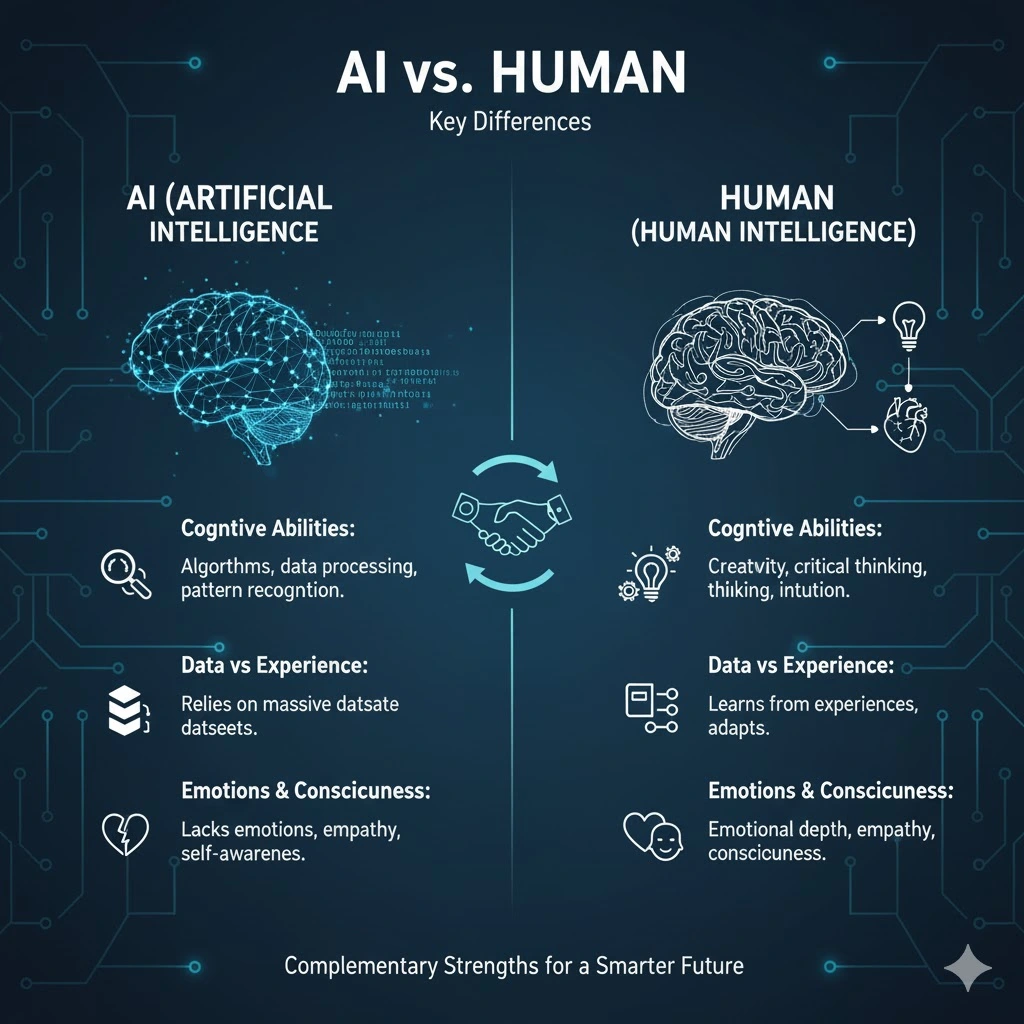
AI is like a super helpful friend that can do lots of cool things to make life easier. AI startup in India are developing solutions that help people complete tasks faster and make life more convenient and enjoyable. AI is data-driven, excels at speed, accuracy, and pattern recognition in repetitive tasks, while human intelligence encompasses creativity, emotional intelligence, common sense, and adaptability. AI cannot fully replicate human consciousness or empathy, whereas humans possess intuition and the ability to make nuanced decisions based on social context.
Key Differences
1. Cognitive Abilities:
- AI : Startups like Krutrim and Sarvam AI have moved beyond basic text. They now use Multimodal LLMs to process voice, text, and images across 22+ Indian languages simultaneously. They excel at “Knowledge Retrieval” and “Chain-of-Thought” reasoning for complex enterprise tasks.
- Humans: Humans possess Social and Cultural Intelligence. While an AI can translate a marketing campaign into Marathi, a human expert ensures the tone respects local “etiquette” and “slang,” ensuring the brand message resonates deeply with a local audience
2. Data vs. Experience:
- AI: Modern AI relies on Ethical Data Cooperatives. Companies like Karya provide high-quality, human-labeled Indian datasets that allow AI to learn regional nuances. However, AI still requires millions of data points to “understand” a new trend.
- Humans: Humans learn from a “Sample Size of One.” We can adapt to a sudden change like a new Indian government regulation or a sudden shift in consumer sentiment instantly, without needing a massive data “re-training” phase..
3. Emotions and Consciousness:
- AI: AI: Startups like Uniphore use Emotion AI to detect tonal shifts, silences, and frustration in a customer’s voice with 99% accuracy. However, the AI is only simulating empathy based on frequencies; it does not “feel” the customer’s problem.
- Humans: Humans provide Authentic Empathy. In critical sectors like Healthcare, an AI might diagnose a condition faster than a human, but the human doctor provides the ethical guidance and emotional reassurance that a machine cannot replicate.
Future ready with AI:
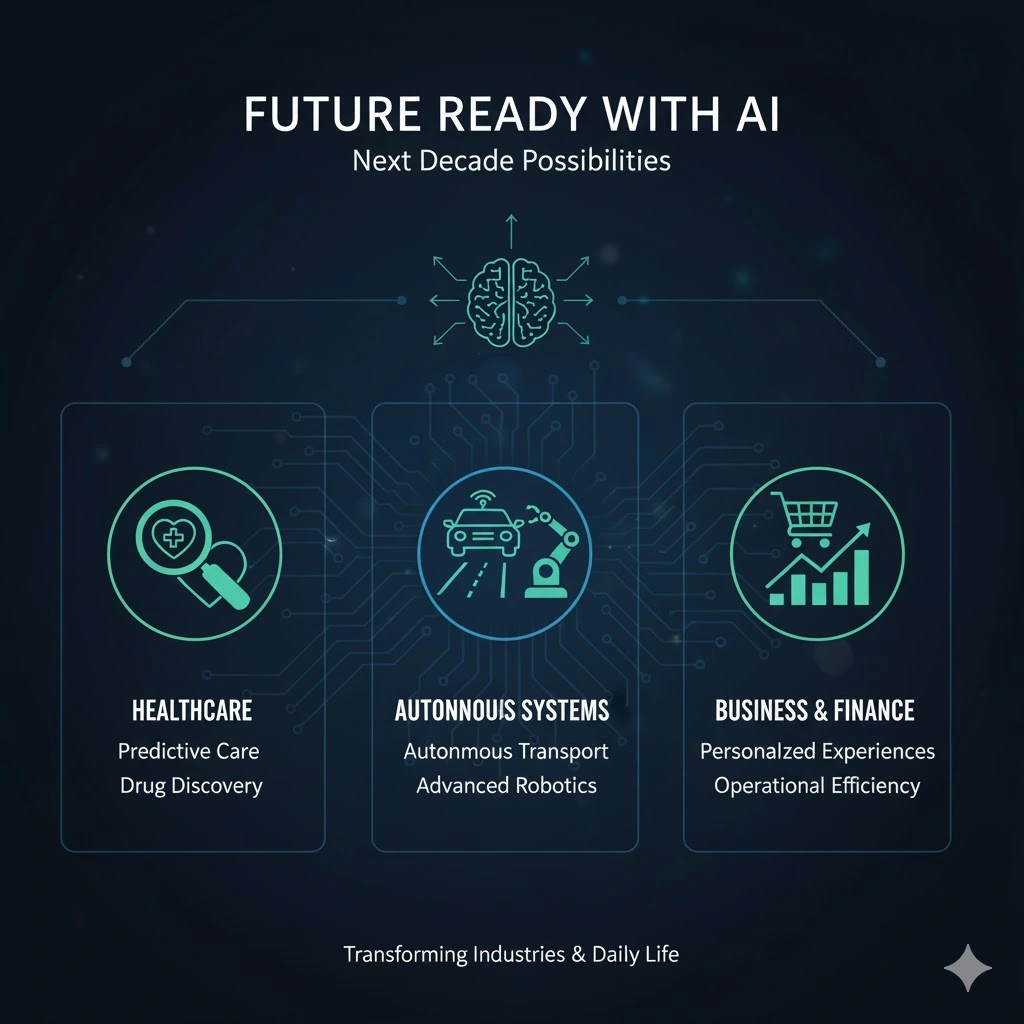
Future AI possibilities include advancements in autonomous systems, revolutionizing healthcare through predictive diagnostics and personalized treatment, enhancing cybersecurity with live threat detection, and creating highly personalized customer experiences in retail and finance. Just as learning how to invest in stock market empowers individuals to make informed financial decisions, AI startup in India are helping industries understand and adapt to AI innovations, empowering them to make smarter, data-driven choices. AI will also likely transform the workplace through human-AI collaboration and by automating complex decision-making processes.
Healthcare
- Predictive Care and Diagnostics: AI will continue to evolve for analyzing medical images, facilitating early disease detection, and developing personalized treatment plans.
- Drug Discovery: Advanced AI systems can accelerate the discovery of new materials and potential treatments.
Autonomous Systems
- Transportation: Fully autonomous vehicles will become more prevalent, optimizing routes and improving efficiency in transportation and logistics.
- Robotics: Robots will become more capable of navigating complex environments, performing inspections, and even assisting in hazardous industries like mining and construction.
Business and Finance
- Personalized Experiences: AI will drive more sophisticated personalization in retail and finance by analyzing vast customer data to predict preferences and behaviors.
- Operational Efficiency: AI will streamline operations by automating repetitive tasks, optimizing inventory, and improving overall decision-making in various business functions.
Conclusion
In conclusion, the intersection of AI technology is a game-changer for AI startup in India. They must not only focus on technological innovation but also on strategies that include content marketing, social media outreach, and influencer partnerships. Partnering with expert digital marketing agencies like Shark Mondo can help these startups build a strong brand presence, educate the market, and ultimately achieve success in an increasingly competitive landscape. AI technology is transforming AI startup in India, and as the AI ecosystem matures, creating awareness, educating the market, generating leads, and building customer relationships are crucial.