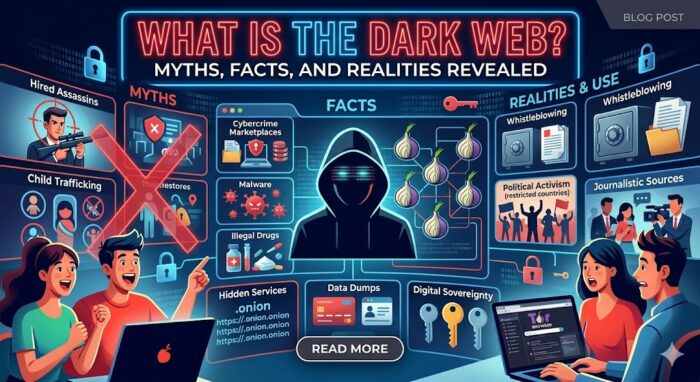
What Is the Dark Web?
Introduction
What Is the Dark Web? The dark web is a part of the internet that’s hidden from the regular public eye. The technology behind the dark web began in 1999 with Ian Clarke’s Freenet Project, which was released to the public in 2000 to provide anonymous communication. The dark web originated in the United States, emerging from research by the U.S. Department of Defense and the U.S. Naval Research Laboratory in the late 1990s to develop the Tor network (The Onion Router) for secure, anonymous communication.
What is Dark Web? & Its Uses
What Is the Dark Web? The dark web is like a secret part of the internet that’s not easily accessible. It’s like a hidden world where people can communicate and share stuff without revealing their identity. The dark web is not meant for the general public since it is harder to access and needs technical knowledge. Though the dark web is popularly associated with illegal activities, it is also used by the intelligence community, whistleblowers, members of the media, and ordinary citizens whose communication may be monitored or restricted by the government.
Common Uses of the Dark Web
Despite its reputation, the dark web is used for various purposes—both positive and negative.
Legitimate Uses
- Privacy Protection : For journalists, whistleblowers, or citizens in oppressive regimes, the dark web offers a platform to share information without censorship.
- Whistleblowing Platforms : Sites like SecureDrop allow whistleblowers to safely communicate with journalists.
- Political Activism : Dissidents and activists can share content safely in countries where free speech is restricted.
- Cybersecurity Research : Ethical hackers and security experts explore the dark web to track threats or recover stolen data.
Illicit Uses
- Black Markets : Selling drugs, weapons, fake documents, and more (e.g., the now defunct Silk Road marketplace).
- Stolen Data : Credit card information, social security numbers, login credentials, and hacked databases.
- Illegal Services : Hacking services, contract killings (allegedly), counterfeit money, and fake IDs.
- Child Exploitation Material : Unfortunately, this remains one of the darkest corners of the dark web.
- Scams and Fraud : Phishing schemes, Ponzi scams, and other forms of deception.
Difference Between Dark Web & Open Web
The Normal Web, also called the surface web, is publicly accessible via browsers and indexed by search engines like Google. In contrast, What Is the Dark Web? It is a small, intentionally hidden subset of the internet, requiring special software such as the Tor browser to access and providing enhanced anonymity through layered encryption.
What Is the Dark Web? While the Normal Web contains everyday content, the Dark Web is notorious for its association with illegal activities like drug and weapons trafficking but also serves legitimate purposes such as encrypted communication for journalists and whistleblowers.
Key Differences
| Feature | Normal Web | Dark Web |
|---|---|---|
| Accessibility | Standard browsing, indexed by search engines | Requires special browsers (e.g., Tor) |
| Content | Public websites | Hidden websites |
| Primary Use | General information, communication, online services | Anonymous or illegal activities |
Layers of Web Accessibility (Content)
- Surface Web (Visible Web): Publicly accessible sites indexed by search engines (Google, Bing) like social media, news sites, blogs.
- Deep Web: Content not indexed by search engines, requiring login or direct URL, including online banking, email, databases, medical records.
- Dark Web: A small, encrypted part of the Deep Web, requiring anonymity tools like Tor, used for both illicit and privacy-focused activities.
Advantages and Disadvantages of Dark Web
| Advantage | Disadvantage |
| Privacy and Anonymity | Illegal Activity |
| Freedom of Speech | Cybercrime Risk |
| Access to Restricted Information | Lack of Regulation |
| Secure communication | Access Difficulty and Risk |
Advantages of the Dark Web
The primary advantage of the dark web is the high level of anonymity it provides, which serves several legitimate and important purposes:
- Freedom of Speech and bypassing Censorship: The dark web offers a crucial platform for individuals in oppressive regimes to communicate freely and access censored news without government surveillance.
- Protection for Journalists and Whistleblowers: It enables journalists and whistleblowers to securely share sensitive information and communicate with sources while protecting their identities from potential repercussions.
- Privacy and Security: For everyday users, it provides enhanced privacy for activities like using ad-free search engines, securing cryptocurrency wallets, or simply browsing the internet without being tracked by corporations or government agencies.
- Legitimate Services: Many reputable organizations, including the New York Times, the Guardian, and privacy-focused email services like Proton Mail, host dark web versions of their sites to provide access in restricted areas.
Disadvantages of the Dark Web
The same anonymity that provides legitimate benefits also creates a haven for illegal and harmful activities, which pose significant risks:
- Illegal Activities and Marketplaces: The dark web is notorious for hosting illicit marketplaces where users can buy and sell drugs, weapons, stolen data (like credit card numbers and login credentials), and other contraband.
- Cybercrime and Malware Risks: It is a hub for cybercriminals who distribute malware, viruses, and ransomware. Visiting unverified sites can lead to phishing scams, identity theft, or device infection.
- Malicious Content: Users may inadvertently stumble upon highly disturbing and explicit content, including graphic depictions of violence or child exploitation material.
- Scams and Fraud: Many dark web sites are designed specifically to scam users, often by taking cryptocurrency payments for non-existent goods or services.
- Legal Risks: Engaging in or even accidentally accessing illegal material can lead to serious legal consequences, as law enforcement agencies actively monitor the dark web for criminal activity.
Reality & Myths
- Myth : The dark web is a huge part of the internet.
- Reality : It’s actually quite small compared to the rest of the internet.
- Myth : Everything on the dark web is illegal.
- Reality : Some things are illegal, but it’s also used for safe communication by people like journalists and activists.
- Myth : Just visiting the dark web is illegal.
- Reality : Visiting the dark web isn’t illegal, but doing illegal things there is.
- Myth : The dark web is completely anonymous.
- Reality : While it offers some privacy, it’s not entirely anonymous.
- Myth : There are “red rooms” where you can watch live torture.
- Reality : There’s no proof that these “red rooms” actually exist like people claim
How Does the Dark Web Work?
Accessing the dark web typically involves:
- Downloading the Tor Browser – This browser is configured to connect to the Tor network.
- Connecting to onion Websites – These are domain names specific to the dark web, often shared via private forums or directories.
- Browsing with Anonymity – Tor routes your traffic through multiple nodes, making it difficult to trace.
What Is the Dark Web? The Tor network protects both the user’s identity and the location of the websites. This double-anonymity is why the dark web has become a haven for both privacy advocates and cybercriminals.
Popular Dark Web Platforms and Tools
While dark web sites are not widely advertised, several tools and platforms have gained attention:
- Tor Browser : The most common tool to access the dark web. It routes traffic through multiple nodes for anonymity.
- I2P (Invisible Internet Project) : Another anonymous network used for secure communication and hosting anonymous websites.
- Tails OS : A live operating system focused on privacy and anonymity. It can be booted from a USB stick and doesn’t leave traces on the host computer.
- onion Sites : Websites on the dark web have a “. onion ” suffix. They are often long and random.
- Dark Web Marketplaces : Some marketplaces are modeled after e-commerce websites like Amazon or eBay but deal in illegal goods.
- The following are the Top 8 Dark Web Tools used for Open Source Intelligence Professionals:
TOR Browser.
Ahmia.
HayStack.
Tor66.
Torch.
Onion Engine.
Telemetry.
Library of Leaks.
Dangers and Risks of using the Dark Web
While the dark web offers anonymity, it also comes with significant risks:
- Illegal Content : Many sites contain disturbing or illegal material. Even accidentally accessing this content could have legal consequences.
- Cyber Threats : Malware, ransomware, keyloggers, and spyware are common. Simply visiting a malicious site can compromise your system.
- Scams : What Is the Dark Web? Fake marketplaces, fraudsters, and phishing sites are rampant. Because transactions are anonymous and in cryptocurrency, there’s little recourse if you’re scammed.
- Surveillance : What Is the Dark Web? Despite the anonymity, law enforcement agencies monitor parts of the dark web. Accessing or participating in illegal activities can lead to investigation or arrest.
- Psychological Impact : Viewing disturbing content or interacting with dangerous communities can take a mental toll.
Security laws for dark web
Authorities around the world have made efforts to curb illegal activities on the dark web. Some notable operations include:
- Operation Disruptor (2020): Resulted in the arrest of 179 individuals and the seizure of $6.5 million in cash and cryptocurrencies.
- Silk Road Takedown (2013): The FBI shut down the Silk Road marketplace and arrested its founder, Ross Ulbricht.
- AlphaBay Shutdown (2017): Once the largest darknet market, AlphaBay was taken down by international law enforcement.
Governments use advanced cyber forensics, undercover agents, and even create honeypots (fake illegal sites) to catch criminals.
Law Enforcement and the Dark Web
Authorities around the world have made efforts to curb illegal activities on the dark web. Some notable operations include:
- Operation Disruptor (2020): Resulted in the arrest of 179 individuals and the seizure of $6.5 million in cash and cryptocurrencies.
- Silk Road Takedown (2013): The FBI shut down the Silk Road marketplace and arrested its founder, Ross Ulbricht.
- AlphaBay Shutdown (2017): Once the largest darknet market, AlphaBay was taken down by international law enforcement.
Governments use advanced cyber forensics, undercover agents, and even create honeypots (fake illegal sites) to catch criminals.
Should You Access the Dark Web?
What Is the Dark Web? Honestly, unless you have a really good reason, it’s best to steer clear of the dark web. The risks are high, and for most people, the benefits just aren’t worth it.
Why you should be careful with the Dark Web :
- It’s not safe : Lots of bad people and viruses.
- You might see bad things : Some content is really disturbing.
- Scammers are everywhere : They’ll try to steal your money.
- You might get in trouble : Even visiting some sites can get you in trouble.
It’s safer to use the regular internet.
Beyond Crime : The Role of Dark Web
What Is the Dark Web? The dark web is not only associated with crime; it also protects people’s privacy. Research and education play a very important role in the dark web to understand hacking, cybercrime, and online fraud. The government also works in this area by innovating ideas and using strong tools to safeguard the internet and people’s personal data.
UNEXPECTED BENEFITS OF DARK WEB
What Is the Dark Web? The dark web seems like a dangerous place, but it also has some unexpected benefits. It helps protect privacy, supports free speech, and contributes to cybersecurity research, among other positive uses.
- PROTECT PRIVACY : Dark web helps people stay private and secure online. share information safely without tracked or watched.
- HELPS IN CYBERSECURITY : What Is the Dark Web? Dark web also helps to find stolen data and cyber threats. This helps companies and governments to protect their data from hackers attack.
Dark web is about cybercrime , online behaviour and online issues and the internet helps to save the data and make benefits for everyone.
FUTURE OF DARK WEB
- What Is the Dark Web? In the future, the dark web will become a powerful platform for privacy and security. As online tracking and hacking increase, more people will use it to protect their personal information and personal data.
- Growth in research helps to find cyber threats and hacker networks and this will help to improve cybersecurity and data protection.
- What Is the Dark Web? The dark web will always have both positive and negative sides. The negative side appears when some people misuse it and hack others’ privacy and freedom of speech. The future depends on how responsibly people use it.
FUTURE OF DARK WEB IS ABOUT FOR PRIVACY , SECURITY , CYBERSERCURITY AND FREEDOM OF SPEECH ETC . HOW CAREFULLY PEOPLE WILL USE INTERNET AND HOW MANY PEOPLE MISUSE IT.
GOVERNMENT ROLE IN THE DARK WEB
- What Is the Dark Web? The government plays a very important role in keeping an eye on the dark web. The government uses special tools to track illegal activities like drug sales, online threats, etc.
- The government helps to protect the personal data and prevent identity theft , online threats and online fraud .
- Many governments are making new cyber laws and policies and these laws help to save the internet .
The government’s role is to protect people , prevent illegal activities and protect the internet by using strong tools for cybercrime .
Final Recommendations & Conclusion
What Is the Dark Web? The dark web is a mysterious and controversial part of the internet. It represents both the potential for freedom and privacy and the dangers of illegal activity and exploitation. While it’s not inherently illegal to access the dark web, what you do there matters. Platforms like Shark Mondo, a digital marketing agency, often discuss trending topics such as Low Investment Business Ideas while educating users about the safe and ethical use of online spaces like the dark web.