Advantage and disadvantage of AI
Introduction
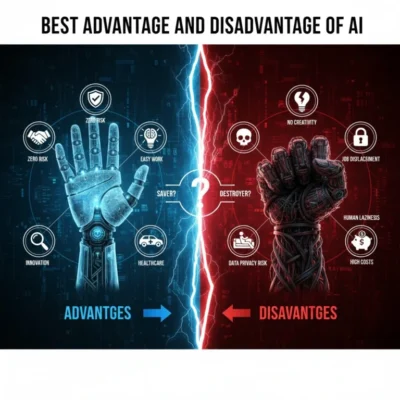
AI is becoming an important part of life. It changes our lives, work and helps us to know about new technology. We all now use AI from smart assistance for automatic vehicles and to invent new medicines. When we talk about the Advantage and disadvantage of AI, there are several advantages like: easy to work, help us live with trends, help in education and handle to complete the task.
However on the other hand, there are several disadvantages like job displacement, conflict in choices and risk. According to a report, more than 378 million people are using AI and also according to the study of Stasita the market rose up to 54%. Now people want to understand the Advantage and disadvantage of AI because there is a confusion, is it a saver or destroyer?
What is AI?
It can think, learn and make decisions like humans. It can also solve problems like humans but uses algorithms and data to do so. AI can easily change images, voice, text and also make predictions. While understanding how AI works, it is also important to know the Advantage and disadvantage of AI because AI is a human invention that can change the world.
Before and After AI
Before AI
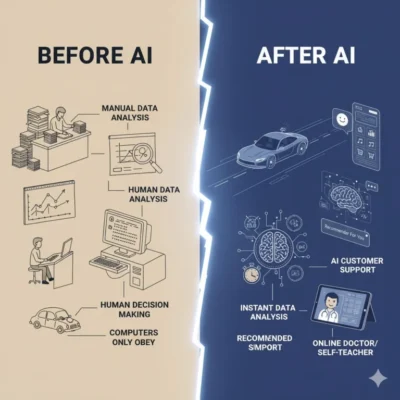
When there is no use of AI, all the things are manual. People have to work and analyse the data and make decisions on it. Computers only do what the person says. Earlier there was no AI assistant for customer support, chatbot, doctor online, self-teacher and automatic cars via AI. That is why understanding the Advantage and disadvantage of AI helps us realise how technology has changed our lives from manual work to smart automation.
After AI
The things are now done with the help of AI. There is an AI assistant for customer support, self-driven cars and better combination medicines. Through AI, online entertainment platforms have an option of “recommended for you.” Through AI, online shopping platforms now show the things you like and need. AI helps to analyse long data in a minute, but to understand its impact on our daily life, we must also know the Advantage and disadvantage of AI.
Advantage And Disadvantage of Artificial Intelligence
AI – Artificial Intelligence helps to solve critical problems and AI systems analyse data and use logic to learn from patterns. AI provides help to computer programs with the ability to think and learn independently. It is a human intelligence in machines to perform tasks we typically rely on humans for, but to fully understand its role in our lives, it is important to know the Advantage and disadvantage of AI.
Advantages of AI
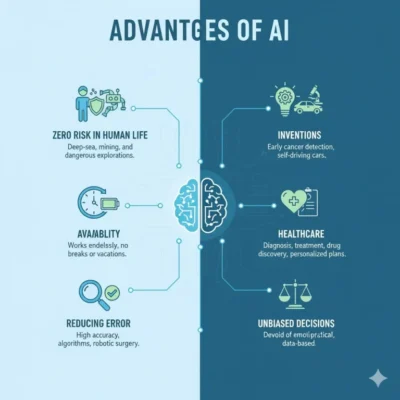
- Zero Risk in human life : AI robots can undertake dangerous tasks on behalf of humans like deep sea missions, mining on Earth and even on Mars. Nature is very cruel if humans want to explore the hidden part of it. Humans cannot survive in various extreme conditions of Earth, unlike AI robots, but while using such advanced technology, we must also understand the Advantage and disadvantage of AI.
- Availability : A study shows that humans usually take a break after 3-4 hours in a day and also need vacations to balance their work and personal life. On the other hand, an AI can work endlessly without interruption.AI executes tasks faster than humans and can-do multiple tasks simultaneously with zero error.
- Reducing Error : The best advantage of AI is significantly reducing errors and increasing accuracy. AI takes the best decisions and gathers the best information with the help of specific algorithms. For examples – robotics and surgery can perform complex surgeries with precision. However, while talking about such benefits, we should also consider the Advantage and disadvantage of AI to understand its complete impact.
- Inventions : AI is the driving force behind many innovations that help solve complex issues. For example, advancements have allowed doctors to detect breast cancer in women at an early stage, and self-driving cars ,robotics machines have revolutionized AI usage.
- Healthcare : AI has made significant contributions to medicine, from diagnosis and treatment to drug discovery and clinical trials.AI tools can help doctors and researchers to analyse patient data, identify potential health risks , and develop personalized treatment plans ,leading to better health outcomes and faster development of new medical treatments and technologies.
- Unbiased Decisions : Unlike humans, AI is devoid of emotions and it is very practical and rational in its approach. One significant advantage of AI is that it does not have biased opinions, ensuring more accurate decisions based on given data and timeframe. However, while discussing its role in decision-making, it is also important to understand the Advantage and disadvantage of AI. Unlike humans, AI doesn’t have emotions or personal bias. It doesn’t get influenced by feelings, status, or pressure. The best thing about AI is that it makes logical and data-based decisions not emotional ones. It checks data fairly and gives results that are more consistent and accurate (but only if it’s trained properly).
Disadvantage Of AI
-
- NO Creativity : Ai cannot think outside the algorithm. it can learn over time from pre-fed data and past experience but cannot be creative in its approach.
-
- Unemployment : AI is robots, which can lead to job displacements and increased unemployment in the future. Companies are using AI to replace human resources in every field as it’s cheaper than humans. This is one of the major concerns when discussing the Advantage and disadvantage of AI.
-
- Making Humans Lazy : AI applications automate most of the boring and repetitive tasks. Human beings don’t need to remember things or solve puzzles to get the job done; we tend to use our brains less. This addiction to AI can cause problems for future generations.
-
- NO Emotions : From early childhood, we learn that neither computers nor other devices have emotions. Humans work as a team, and team management is crucial to achieving goals. While robots outperform humans in efficiency, it is also true that the human touch in communication which forms the basis of teams, cannot be replaced by computers.
-
- High Financial and Environmental Costs (Advantage and Disadvantage of AI): Developing and running advanced AI systems is very expensive and energy-intensive. Training large AI models requires powerful hardware, vast data, and huge electricity use, which leads to high carbon emissions. Maintaining AI systems also needs constant updates and costly infrastructure, increasing financial pressure on companies and governments.
This is one major disadvantage of AI, as it not only raises costs but also harms the environment due to excessive energy consumption. However, from the advantage and disadvantage of AI point of view, while AI helps improve efficiency and innovation, its high financial and environmental costs make sustainability a growing concern for the future.
-
- AI in Education : A study confirm that if a students uses the AI tool to solve the equations and questions can loss the reasoning minds and it’s not good for students, students to see how to solve problems, AI can destroy the innovative ideas and minds at later stage AI can stop thinking power and mind thoughts.
-
- Data privacy issue : To use AI, we often add our images, IDs and documents to get better and more accurate outcomes. However, AI is created by humans, and it’s a program that performs and executes the output while saving data for more precise results. It can be dangerous if an ignited mind executes a program to retrieve personal data from AI, which highlights another concern when discussing the Advantage and disadvantage of AI.
-
- The Challenge of Algorithmic Bias: AI aims to make fair decisions, but it learns from human data, which often carries hidden bias. When trained on such data, AI can uncaused favor or discriminate against certain groups, a problem known as algorithmic bias. For instance, hiring AIs may prefer male candidates if past data favored men, or facial recognition may misidentify darker skin tones due to limited training diversity.
These biases can cause unfair outcomes in jobs, banking, or healthcare. Since AI systems are complex and lack full transparency, detecting or correcting these biases is difficult. Ensuring fairness and ethical AI use requires diverse data, regular audits, and accountability in how AI decisions are made.
When we discuss the Advantage and Disadvantage of AI, we can clearly see that artificial intelligence offers great benefits but also creates serious challenges.
Lack of Transparency and Accountability
Highly complex AI systems, mainly those using deep learning, even developers cannot always explain how or why they reached a particular conclusion. This raises serious concerns, especially in fields like healthcare, law, finance, and recruitments, where decisions can deeply affect human lives. When we talk about the Advantage and Disadvantage of AI, this lack of transparency becomes one of the biggest disadvantages, as it questions trust and accountability in automated systems.
For instance Advantage and Disadvantage of AI if an AI algorithm denies someone a loan, suggests unfair jobs, or misdiagnoses a patient, it becomes difficult to establish who is responsible the developer, the user, or the system itself. This lack of accountability highlights a major disadvantage of AI, as it creates mistrust and raises serious ethical concerns.
Furthermore, most organizations do not make information about data collection, processing, and utilization by their AI systems available to the public. This lack of transparency limits the ability to raise questions or verify results driven by AI. When discussing the advantage and disadvantage of AI, this issue becomes crucial because while AI offers automation and efficiency, its opaque decision-making process can lead to confusion, unfair outcomes, and reduced public trust.
To fully understand the Advantage and Disadvantage of AI, we must look at how it affects jobs, education, healthcare, and daily life.
The Importance of AI: Driving Global Innovation
Artificial Intelligence has become the backbone of modern innovation. It powers breakthroughs in almost every industry from healthcare and agriculture to finance, space exploration, and entertainment. AI enables organizations to automate complex tasks, analyze massive datasets in seconds, and create personalized experiences for billions of people worldwide.
In healthcare, AI helps in early diagnosis and drug discovery; in education, it personalizes learning experiences; in transportation, it powers autonomous vehicles; and in business, it predicts trends and customer behavior. Governments and global companies are investing billions into AI research, recognizing it as the key driver of the Fourth Industrial Revolution.
However, as AI continues to evolve, it is crucial to balance its benefits with ethical considerations and understand both the Advantage and Disadvantage of AI to ensure innovation serves humanity, not replaces it.
Contributions of AI-Powered Systems in Transforming Various Sectors
The Growing Role of Artificial Intelligence in the Healthcare Sector
In today’s rapidly evolving world, Artificial Intelligence (AI) is surely going to make remarkable progress in the healthcare and medical industry in upcoming years.
AI in Medical Diagnosis and Disease Detection
One of the most impactful applications of AI in healthcare is medical diagnosis. AI powered machines are used to analyze X-rays, MRIs, and CT scans, enabling faster and accurate detection of diseases. , reducing the chances of human error and improving diagnostic efficiency.
AI-Powered Virtual Assistants and Chatbots
Another significant role of AI is the use of virtual health assistants and chatbots. These chatbots help patients with symptoms checking, appointment scheduling, and routine medical reminders . AI-driven chatbots provide immediate support, improve patient engagement, and reduce communication gap between patient and healthcare staff
While studying the Advantage and Disadvantage of AI, it becomes clear that AI improves speed, accuracy, and efficiency in many fields.
Online Consultation and Personalized Treatment Plans
With the help of AI, online medical consultations have become much easier and more reliable for patients, who can receive regular check-up reminders, treatment plans, and follow-up guidance without frequent visits to the hospital. AI-powered systems also support personalized treatment by analyzing patients’ past data.
Role of Artificial Intelligence in the Financial Sector
Artificial Intelligence (AI) is playing a significant role in transforming the financial sector by improving security, efficiency, and customer experience. Its adoption is rapidly increasing across many countries, with several technologies already implemented and others currently in trial phases.
Fraud Detection and Risk Reduction
One of the most important contributions of AI in finance is fraud prevention. AI systems are evolved enough to recognize patterns and detect unusual or suspicious activities by automatically stopping the transaction.
This technology is already being used in several countries and is continuously evolving. For example, China’s *Palm Recognition Technology* is a highly advanced and engaging innovation that enhances secure and seamless financial transactions.
AI in Customer Service and Support
AI has significantly improved *customer service in the financial sector*. Through AI-powered chatbots and automated systems, customers receive instant assistance for frequently asked questions.Transaction updates are also handled automatically any transaction made is immediately detected, updated, and reflected in the system without manual intervention.
The integration of AI has created a strong positive impact on the financial sector, including:
-
- 24/7 customer support without human dependency
-
- Better investment-related insights and decision-making
-
- Faster loan approvals through automated analysis
-
- Significant reduction in fraud losses
Role of Artificial Intelligence in the Manufacturing Sector
Artificial Intelligence (AI) helps the manufacturing industry by improving operational efficiency, product quality, and cost management. by advanced data analysis and automation, AI benefits manufacturers in predicting issues, in optimizing processes, and in reducing downtime.
Predictive Maintenance and Machine Failure Prevention
AI can predict machine malfunctioning by continuously monitoring its performance. AI can detect early warning signs such as reduced system efficiency, loose wiring connections, or potential mechanical damage before a failure occurs.
By identifying these issues in advance, AI helps in preventing unexpected machine breakdowns and helps in ensuring smoother production operations.
Quality Control and Defect Detection
AI-powered systems can effectively detect quality control issues. If a machine begins producing defective products due to internal issues, AI-powered systems instantly stop the manufacturing process to take corrective action at an early stage, reducing waste and maintaining consistent product quality.
The implementation of AI in manufacturing results in multiple operational benefits, including:
-
- Higher product quality
-
- Faster production cycles
-
- Reduced product defects
Case Study
During the COVID-19 pandemic, hospitals started using AI-based tools to quickly detect infections from X-rays and CT scans. Apollo Hospitals in India used AI to identify lung infections in patients within minutes, saving many lives. AI also predicted which patients needed urgent care. However, some concerns arose, such as inaccurate predictions and data privacy issues, as sensitive health data was being stored online. Nevertheless, AI reduced doctors’ workload and significantly increased accuracy. This case clearly shows that if used smartly, AI can be a game-changer. Just be sure to use AI in a balanced manner, avoiding misuse, and maintaining ethical standards.
As technology grows, the Advantage and Disadvantage of AI becomes more important to understand because AI will play a major role in the future.
FAQ
Q1. What is the main conclusion about AI?
AI is a powerful technology that makes life easier, faster, and more efficient, but it also comes with risks like unemployment, bias, and data privacy issues.
Q2. Is AI more helpful or harmful?
AI is helpful when used responsibly. It supports innovation, improves healthcare and education, but can be harmful if it replaces human jobs or is misused without ethical control.
Q3. Can AI replace humans completely?
No. AI can perform tasks efficiently but lacks creativity, emotions, and moral judgment. Human intelligence and empathy are still irreplaceable.
Q4. Why should we balance AI use?
Because excessive dependence on AI can lead to laziness, job loss, and privacy concerns. Balancing AI with human skills ensures sustainable growth and innovation.
Q5. What is the final takeaway?
AI should be used as a tool to support humans, not to replace them. The goal is to create a future where AI and humans work together for progress, safety, and innovation.
Q6. What is the biggest risk of AI?
The biggest risk of AI is misuse and lack of proper control, which can lead to biased decisions, privacy issues, and harmful outcomes without human oversight.
Conclusion
As we have considered the Advantage and disadvantage of AI, we all know AI is a technology invented by humans to change the future of humankind. In today’s world, the human population increases day by day and we have more minds working for their livelihood; however, rapid use of AI can create problems in finding jobs as AI is cheaper than the human mind. Just like trending digital topics such as How to Buy Cryptocurrency in India show how fast technology is evolving, AI is also reshaping industries and transforming opportunities, both positively and negatively.
We cannot trust machines; if any malfunction occurs, our years of efforts and hard work can go in vain. AI stores data to execute better performance, but that can also lead to data breaches and privacy issues at any stage. We can trust algorithms, however, we cannot fully rely on results as raw data is uploaded by humans only. As AI is a bunch of algorithms and programs, it does not have a face or emotions. It can answer, but it cannot express feelings the way humans do. Even digital marketing agencies like Shark Mondo emphasize that while AI tools are helpful for improving productivity, human creativity and emotional connection can never be replaced.
The Advantage and Disadvantage of AI also shows that too much dependence on machines can lead to problems like unemployment, privacy risks, and reduced human creativity.
We can use AI for help or for overview but we need to focus on humans to save the ignited minds
कृत्रिम बुद्धिमत्ता (AI) एक ऐसी तकनीक है जो मशीनों को इंसानों की तरह सोचने, सीखने और निर्णय लेने में सक्षम बनाती है। इसके कई फायदे हैं जैसे तेज़ और सटीक काम, 24 घंटे काम करने की क्षमता, गलतियों में कमी, शिक्षा और स्वास्थ्य में सुधार, और नई खोजों में मदद। लेकिन इसके नुकसान भी हैं जैसे बेरोज़गारी बढ़ना, रचनात्मकता की कमी, डेटा चोरी का खतरा और मशीनों पर ज़रूरत से ज़्यादा निर्भरता। इसलिए, AI का उपयोग सोच-समझकर करना चाहिए ताकि यह इंसानों की मदद करे, न कि उन्हें पूरी तरह बदल दे।