Table of Contents
Augmented Reality vs Virtual Reality
1. AR vs. VR: The Ultimate Reality Check
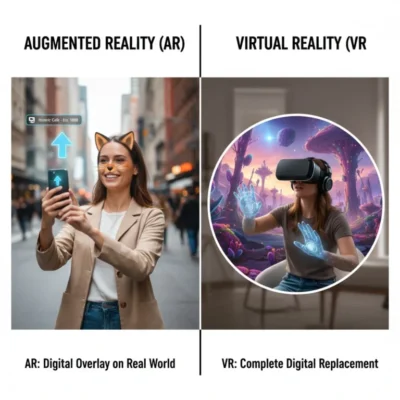
This section sets the stage by clearly defining the two core technologies, which is essential because they’re often confusingly grouped together. The key differentiator is where the digital content lives.
Defining Digital Overlay (AR)
Augmented Reality (AR) is about taking the real world and simply laying digital information on top of it. Think of it like a smart filter. Your real surroundings remain visible and central, but you’re getting an enhancement like a Snapchat filter over your face or the line showing you where to walk on Google Maps.
Many people use AR for shopping, education, also for the social media filters. AR is mostly used on smartphones and tablets. AR keeps you grounded in reality while giving it a digital boost. When we talk about Augmented Reality vs Virtual Reality, AR enhances the real world, whereas VR completely immerses you in a simulated one. The main goal of AR is to make real life more useful and interactive.
Defining Simulated Worlds (VR)
Virtual Reality (VR), on the other hand, is a complete digital replacement. It cuts you off from the real world entirely to transport your senses sight, and often sound into a fully computer-generated environment. It creates an artificial, believable, and separate universe for you to interact with.
VR requires special headsets like Meta Quest or PlayStation VR and It is commonly used in gaming, training, virtual tours, social interaction and also virtual classrooms . VR makes the user feel like they are inside a different world and actually experience it. When comparing Augmented Reality vs Virtual Reality, VR offers full immersion, while AR blends the digital and real worlds together.
Today, both Augmented Reality and Virtual Reality are generally used in gaming, education, healthcare, enterprise training, which makes understanding their differences between AR and VR more easily
2. The Reality-Virtuality Continuum Explained
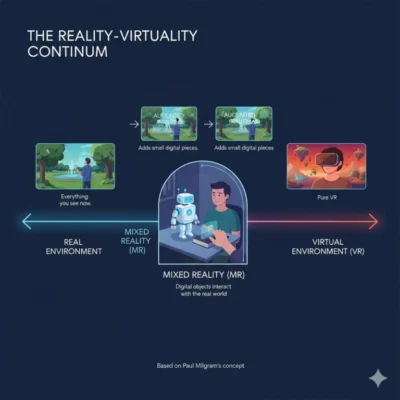
This heading introduces a critical theoretical framework that helps position AR and VR not as opposites, but as points along a spectrum ranging from the completely real to the completely virtual.
Where AR and VR Sit on the Spectrum
The Reality-Virtuality Continuum is a concept from computer scientist Paul Milgram. On one end is the Real Environment (everything you see now), and on the other is the Virtual Environment (pure VR). AR sits close to the real end, as it only adds small digital pieces. VR is right at the virtual end, as it removes all real pieces.
This spectrum helps us better understand Augmented Reality vs Virtual Reality, showing how both technologies exist on different points of the same immersive scale. In simple words, digital elements are replaced the real world and moving towards the virtual reality.
Introducing Mixed Reality (MR) as the Bridge
Mixed Reality (MR) is the sweet spot in the middle, acting as the bridge. It goes beyond simple AR by allowing digital objects to not just overlay, but genuinely interact with the real world they can be blocked by real objects, cast shadows, and be manipulated as if they were physically present. MR blurs the line between the real and virtual, making them co-exist.
Understanding Augmented Reality vs Virtual Reality helps highlight where MR fits on the spectrum, combining elements of both technologies. Mixed Reality is seen as the future because it combines both AR and VR into one experience.
3. The Crux of the Difference: Immersion Level
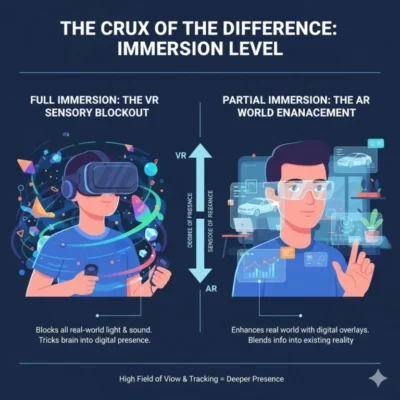
This section zeroes in on the most practical and immediate difference users experience: the degree to which the technology captures their senses and makes them feel present in the digital space.
Full Immersion: The VR Sensory Blockout
The VR Sensory Blockout: VR’s main goal is full immersion. This is achieved by using a completely opaque headset that blocks out all light and sound from the real world. This deliberate sensory blockout is necessary to trick your brain into believing the digital world is real.
The higher the field of view and tracking accuracy, the deeper the feeling of presence, or ‘being there,’ becomes. When considering Augmented Reality vs Virtual Reality, this sensory blockout highlights a key difference: AR keeps you aware of the real world, while VR fully replaces it.
Partial Immersion: The AR World Enhancement
The AR World Enhancement: AR aims for partial immersion. The experience requires you to remain aware of your physical surroundings, so the digital content is designed to enhance rather than replace your environment. Since you see the world clearly, the digital elements are treated as simple world enhancements visual data, 3D models floating in a room, or interactive labels that layer onto your existing sensory input without fully dominating it. In the discussion of Augmented Reality vs Virtual Reality, this demonstrates how AR enhances reality rather than fully immersing you like VR.
4. Hardware Showdown: Headsets vs. Glasses
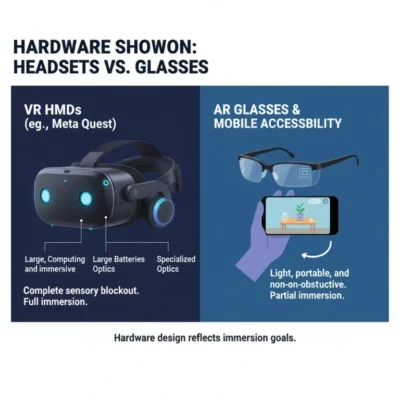
The final topic focuses on the physical devices themselves, which reflect the underlying goals of immersion and accessibility for each technology. The hardware design is a direct result of the required sensory delivery.
The Bulk of VR HMDs (e.g., Meta Quest)
VR requires complex hardware to create that complete sensory blockout and high-resolution visuals. This results in the Head-Mounted Display (HMD), which tends to be large, heavy, and sometimes cumbersome. Devices like the Meta Quest need internal computing power, large batteries, and specialized optics (lenses) to generate a fully convincing, lag-free virtual world, hence their bulk.
When comparing Augmented Reality vs Virtual Reality, this highlights a key difference: AR devices are generally lighter and less intrusive since they only overlay digital content rather than fully replace your surroundings.
The Sleekness of AR Glasses and Mobile Accessibility
AR prioritizes being light, portable, and non-obstructive since it’s meant to be used while moving through the real world. This leads to devices like sleek AR glasses (e.g., Ray-Ban Meta Smart Glasses or consumer prototypes) that are designed to be worn for extended periods.
Even more common is mobile accessibility, where the smartphone screen acts as a ‘window’ for AR, proving that this technology can be delivered via nearly invisible and everyday devices. In the comparison of Augmented Reality vs Virtual Reality, this shows how AR emphasizes convenience and real-world integration, unlike VR, which requires bulky, immersive hardware.
5. How They See the World: Tracking & Mapping
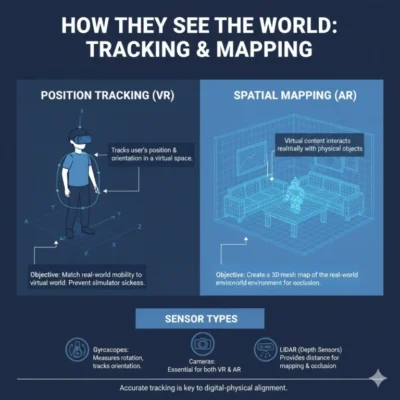
Position Tracking in VR vs. Spatial Mapping in AR
Position Tracking (VR): Primarily consists of understanding where a user is in space and orientation (x, y, z, pitch, yaw, and roll) in relation to a predefined virtual space. The objective is to fully correspond the mobility of the virtual world to the mobility of the user in the real world, to prevent simulator sickness. When discussing Augmented Reality vs Virtual Reality, this highlights a key distinction: VR requires precise tracking for full immersion, whereas AR focuses more on overlaying digital content without needing to fully replicate user movement in a virtual environment.
Spatial Mapping (AR): Primarily it considers the rendering of a 3D mesh or map of the real-world environment (e.g., walls, floors, objects) so that virtual content can realistically interact with and occlude physical objects, accurately combining digital with physical.
Sensor Types: Gyroscopes, Cameras, LiDAR
Gyroscopes measure angular velocity (rotation) in order to track orientation.
Cameras serve a really important role in both.
LiDAR : Any depth sensor provides velocity-enhanced depth and distance information in real time, allowing the construction of a highly realistic spatial map at scale for occlusion and virtual object positioning. In the discussion of Augmented Reality vs Virtual Reality, LiDAR and similar sensors are especially crucial for AR, enabling digital objects to interact accurately with the real world, whereas VR relies more on fully simulated environments.
6. Power and Performance: Which Demands More?
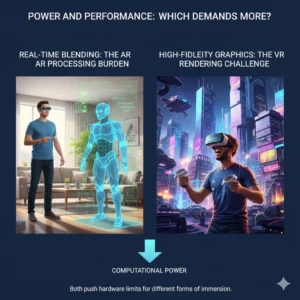
Real-Time Blending: The AR Processing Burden
This highlights the challenges involved in successfully and convincingly merging virtual objects into the real world, and doing it in real-time. For AR systems, the capability to understand and map the user’s physical environment (the “spatial strain”) is crucial. For successful spatial blending, there must be accurate tracking of the user and environment, proper occlusion (so virtual objects appear to sit behind real objects), and matching lighting and shadows to the real scene. If these are inaccurate, the virtual objects may appear to “float” or look obviously fake. When considering Augmented Reality vs Virtual Reality, these challenges emphasize how AR must carefully integrate with the real world, whereas VR operates in a fully controlled, simulated environment.
High-Fidelity Graphics: The VR Rendering Challenge
This highlights the difficulty in rendering very natural graphics at a high frame rate and low latency to ensure a comfortable and immersive VR experience. “High-fidelity” graphics require significant computational power, as the visuals must cover a large field of view and high resolution for viewing close to the eyes challenging for current hardware configurations.
Low performance can induce motion sickness and break immersion. In the comparison of Augmented Reality vs Virtual Reality, this illustrates how VR demands far more computational resources for full immersion, whereas AR can operate smoothly with lighter rendering requirements since it overlays digital content onto the real world.
7. User Control: Input and Interaction
VR: Controllers, Haptic , and Gloves
Controller: Often feels unnatural or bulky; does not map perfectly to real hand movements or dexterous tasks.
Haptics: Limited fidelity, often providing only basic vibration feedback which fails to convincingly simulate the feel of diverse textures, weights, or physical interactions.
Glove: High cost and complexity; calibration can be time-consuming and finicky; introduces resistance or weight.
AR: Gaze, Voice, Gesture
Gaze: Selecting objects by looking at them can be tiring (“gorilla arm” effect for handheld devices); it is slow for precise selection and can feel awkward for social interaction.
Voice: Needs private and quiet settings; can be misinterpreted (accuracy issues) and can socially disruptive.
Gesture: Requires users to learn specific gestures; tracking can suffer due to lighting; hands can get tired over time (often times less comfortable comparing to the hands off a controller).
8. Display Tech: Opaque Screens vs. Transparent Lenses
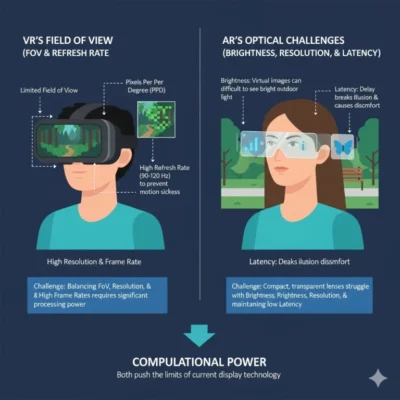
VR’s Field of View (FoV) and Refresh Rate
The constraints of VR’s Field of View (FoV) the perception of space and distance as determined by the headset optics, can produce an unimmersive effect akin to looking through ‘ski goggles.’ Increasing the FoV requires additional pixels, which raises GPU usage and decreases Pixels Per Degree (PPD), a critical factor in perceived fidelity. A higher refresh rate (90−120 Hz) is also important to minimize cybersickness, further increasing processing demands.
Both FoV and refresh rate must be balanced to maintain immersion. When considering Augmented Reality vs Virtual Reality, this highlights how VR faces significant hardware and performance constraints to achieve full immersion, whereas AR typically overlays content without demanding the same extreme rendering performance.
AR’s Optical Challenges (Brightness, Resolution, and Latency)
Display systems for Augmented Reality are limited in brightness, resolution, and latency. For example, in outdoor environments, virtual images must be bright enough to be visible against ambient light. Maintaining high-resolution images is challenging with a compact, see-through form factor. The biggest issue is latency (delay); if a virtual object lags behind the real world, registration fails and the user becomes uncomfortable, breaking the illusion. In the comparison of Augmented Reality vs Virtual Reality, these limitations highlight how AR must carefully balance visibility and responsiveness in real-world conditions, whereas VR operates in a fully controlled digital environment.
9. Training & Simulation: Learning the Digital Way
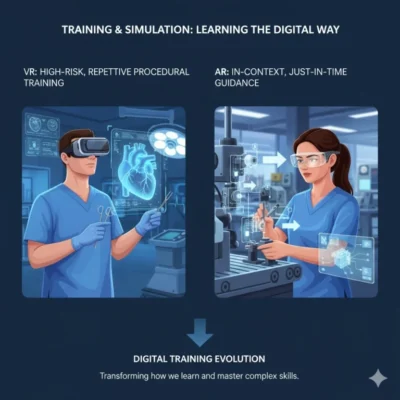
VR: High-Risk, Repetitive Procedural Training (e.g., Surgery)
Virtual Reality is superb at creating a completely immersive, consequence-free environment. This is especially important in high-risk fields like surgery, military, or aviation. Highly skilled professionals can practice complex and critical procedures without risking lives or expensive equipment.
The ability to offer 100% immersion and repeat scenarios is a strong factor in developing muscle memory and decision-making skills, dramatically accelerating performance and reducing errors in real high-stakes situations. When considering Augmented Reality vs Virtual Reality, VR stands out for its full immersion and risk-free training capabilities, whereas AR supplements real-world tasks rather than fully replacing them.
AR: In-Context, Just-in-Time Guidance (e.g., Factory Floor)
Augmented Reality overlays digital instructions directly into the real physical world, offering guidance exactly when and where it’s needed the essence of just-in-time instruction and learning. On a factory floor or during complex maintenance, AR can be delivered via headset or tablet to show the user a sequence of steps for reassembling components or arrows pointing to parts of machinery.
This greatly enhances productivity, reduces errors, and allows people to work hands-on without diverting attention from the task. In the discussion of Augmented Reality vs Virtual Reality, this illustrates how AR supports real-world tasks by augmenting reality, whereas VR immerses users in a fully simulated environment for training or practice.
10. The Future of Gaming and Entertainment
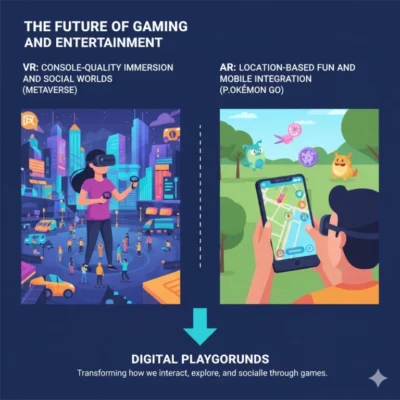
VR: Console-Quality Immersion and Social Worlds (Metaverse)
The defining characteristic of VR is its ability to deliver total immersion, transferring the user into richly rendered, console-quality 3D graphics and game worlds where they can interact with elements of the environment. VR will not only be used for isolated, single-player games but also serve as an essential building block of the Metaverse, creating persistent social worlds where users gather as customizable avatars to interact, play, attend live events, and build communities.
This provides a richer experience of shared presence that is simply not achievable in any other form of screen-based entertainment. When discussing Augmented Reality vs Virtual Reality, VR stands out for full immersion and social interaction in virtual worlds, whereas AR enhances and overlays the digital layer onto real-life experiences.
AR: Location-Based Fun and Mobile Integration (Pokémon GO)
AR can be best defined as digital fun integrated with reality through a mobile device like a smartphone. Location-based games like Pokémon GO create a shared digital experience by turning ordinary physical spaces (parks, streets, landmarks) into interactive play realms. AR is a hybrid experience that adds digital content to wherever the user is standing. Finally, AR can offer something unique by encouraging players to explore the world around them, interact in the real world, and enjoy entertainment on lightweight, easily accessible devices. In the context of Augmented Reality vs Virtual Reality, this highlights how AR merges digital play with the real world, whereas VR immerses users entirely in a virtual environment.
11. Transforming Enterprise and Industrial Work
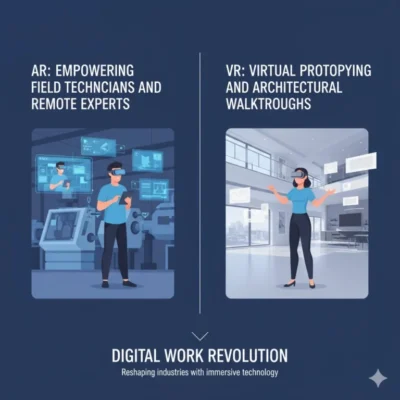
AR: Empowering Field Technicians and Remote Experts
Augmented Reality (AR) provides field technicians the ability to assess a machine or space while receiving specific digital instructions, schematics, or other real-time data. AR also allows technicians to connect with remote experts to see what they are viewing in real time, facilitating visual guidance as the task is completed. This significantly decreases downtime and errors. In the discussion of Augmented Reality vs Virtual Reality, this demonstrates how AR enhances real-world work by overlaying helpful information, whereas VR immerses users in a fully simulated environment for training or testing scenarios.
VR: Virtual Prototyping and Architectural Walkthroughs
Virtual Reality (VR) is a important for the virtual prototyping, which offers to engineers and designers the ability to visualize the complete 3D models of products prior to manufacturing and the construction, thus saving considerable time and costs related to the materials. In real estate, VR visually provides a photorealistic architectural walkthroughs by offering clients and spectators the opportunity to virtually walk through the space and offer feedback based on the design or layout prior to breaking ground.
Virtual Reality (VR) is important for virtual prototyping, offering engineers and designers the ability to visualize complete 3D models of products before manufacturing or construction, saving considerable time and material costs. In real estate, VR provides photorealistic architectural walkthroughs, allowing clients and stakeholders to virtually explore spaces and give feedback on design or layout before construction begins. When comparing Augmented Reality vs Virtual Reality, VR excels in fully immersive visualization and prototyping, whereas AR overlays useful digital information onto real-world objects or spaces.
12. Retail and E-commerce Innovation
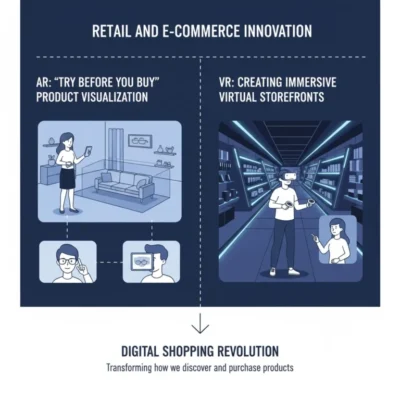
AR: ‘Try Before You Buy’ Product Visualization
Augmented Reality (AR) is leading the “Try Before You Buy” charge in retail. Customers can use their smartphone cameras to visualize products in their own environments everything from how their furniture will fit into their living rooms to how makeup or glasses will appear on their faces. This greatly enhances consumer confidence, therefore reducing returns and bridging the online browsing experience with in-person experience. In the context of Augmented Reality vs Virtual Reality, AR allows consumers to interact with real-world spaces while overlaying digital products, whereas VR would immerse them fully in a simulated environment.
VR: Creating Immersive Virtual Storefronts
Virtual Reality (VR) allows retailers to create a fully immersive version of their virtual storefronts. These go beyond traditional 2-D websites; they are 3-D digital stores where shoppers can walk down aisles, hold and inspect products, and engage with virtual sales personnel. In this case, retailers provide a new, interactive shopping experience that is social and mimics the physical attributes of a store while enticing shoppers to explore. When considering Augmented Reality vs Virtual Reality, VR delivers full immersion in a simulated shopping environment, whereas AR overlays products into the shopper’s real-world space.
13. Healthcare and Medical Applications
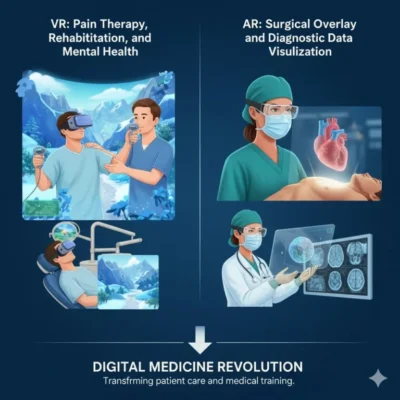
VR: Pain Therapy, Rehabilitation, and Mental Health
The use of Virtual Reality (VR) in healthcare applications is breaking new ground in technology and therapy, often requiring full immersion to distract patients from pain during treatments like burn therapy, chemotherapy, and dental procedures. VR allows for more effective pain management and rehabilitation, as patients engage in sessions immersed in the virtual environment to develop motor control and balance. In the context of Augmented Reality vs Virtual Reality, VR provides full immersion for therapeutic purposes, whereas AR supplements the real world with helpful overlays without fully replacing the patient’s surroundings.
Who will have a stroke and other things. VR therapy is also used for mental health to treat mental disorders such as anxiety, PTSD, and phobias by being able to expose them to each of their fears and anxiety in a simulated manner for the fear or anxiety with all the exposure with the risk of real life. In the context of Augmented Reality vs Virtual Reality, VR offers full immersion to safely confront fears and practice coping strategies, whereas AR would overlay supportive cues or guidance into the real environment.
AR: Surgical Overlay and Diagnostic Data Visualization
Augmented Reality (AR) has precision applications in surgical and diagnostic fields. Surgeons can see organs, veins, or tumors while the patient remains intact using AR glasses. In diagnostic applications, doctors can view and manipulate 3D models of scans or X-rays to improve presence and decision-making quality. AR is also becoming a common experience in medical learning. In the discussion of Augmented Reality vs Virtual Reality, AR enhances real-world medical procedures and training, whereas VR immerses learners in fully simulated medical environments.
14. Usability: Comfort, Safety, and User Experience
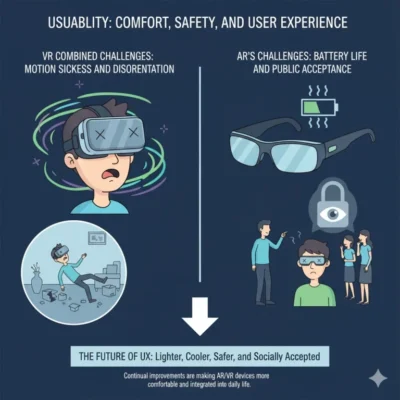
VR Combined Challenges: Motion Sickness and Disorientation
Motion sickness is the single biggest challenge in VR. It occurs when the signals between the brain and eyes do not align, causing users to feel disoriented, dizzy, and nauseous. Developers are addressing this with high refresh rates and consistent tracking. Physical safety is another challenge in VR. When users become fully immersed, it is easy to forget real-world surroundings and collide with objects. In the context of Augmented Reality vs Virtual Reality, this highlights a key difference: VR fully immerses users with these risks, whereas AR keeps users grounded in the real world while overlaying digital elements.
AR’s Challenges: Battery Life and Public Acceptance
People generally view AR as being safer than VR since users are engaged in a real environment. Battery drain and overheating are concerns for AR devices, especially smart glasses. Public acceptance is another issue people may feel uncomfortable wearing AR glasses, and privacy concerns are a barrier. In the years to come, improvements in usability and comfort related to weight and appearance are expected for both Augmented Reality vs Virtual Reality devices.
15. Market Size and Investment Trends
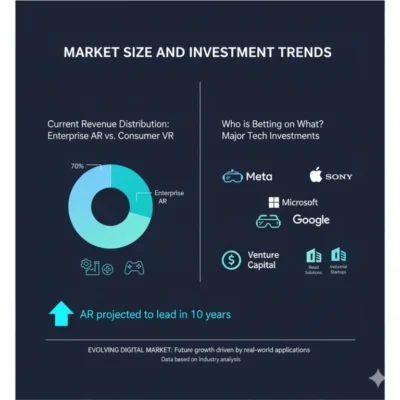
Current Revenue Distribution: Enterprise AR vs. Consumer VR
Presently, the Enterprise AR market is leading with uses in healthcare, education, training, and manufacturing. Consumer VR tends to dominate gaming and entertainment but has experienced slow growth due to cost and limited access. According to market perspectives, in the next 10 years, AR could surpass VR in revenues due to its real-world applications. In the context of Augmented Reality vs Virtual Reality, this illustrates how AR is gaining traction in practical industries, while VR remains strong in immersive entertainment.
Who is Betting on What? Major Tech Investments
Major tech companies have been investing according to their focus. Meta and Sony lead in VR for gaming and Metaverse social use. Apple, Microsoft, and Google are heavily investing in AR, including projects like Apple Vision Pro and HoloLens. Venture capital firms are also funding AR startups focused on retail and industrial solutions. In the discussion of Augmented Reality vs Virtual Reality, this shows how major players are strategically focusing on the strengths of each technology: VR for immersive entertainment and social experiences, and AR for practical, real-world applications.
16. The Next Decade: Convergence and the Metaverse
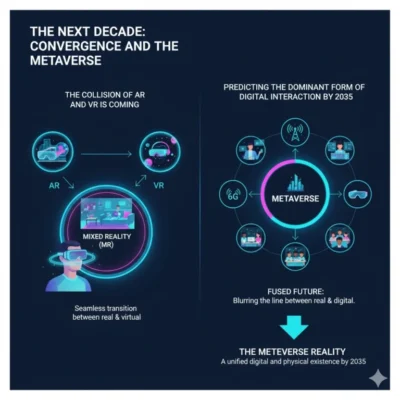
The Collision of AR and VR is Coming
In the coming years, we will observe the dissolution of the divide between AR and VR it will be replaced by Mixed Reality (MR), where real and virtual environments coexist in the same physical space with no concern for any difference. Users will easily transition back and forth between the virtual world and the real world. The deployment of this capability will build seamless, credible, and trustworthy experiences in health, gaming, and education. In the context of Augmented Reality vs Virtual Reality, MR represents the convergence of the two technologies, combining AR’s real-world enhancements with VR’s full immersion.
In the coming years, we will observe the dissolution of the divide between AR and VR – it will be replaced by Mixed Reality (MR) where real environments and virtual environments coexist in the same physical space with no concern for any difference. Users will easily transition back and forth between the virtual world and the real world. Just like choosing the Best Antivirus for Laptop ensures smooth and secure digital experiences, the deployment of this capability is going to build seamless, credible, and trustworthy experiences in health, gaming, and education.
Predicting the Dominant Form of Digital Interaction by 2035
It is believed by 2035 the convergence of AR-VR will be the primary means of human-digital interaction. When AI, 6G, and lightweight wearables are included – we will reach a Metaverse reality where people are working in virtual office space, learning in virtual classrooms, and existing in the digital economy. This fused future technology, as envisioned by Shark Mondo, a digital marketing agency, will permanently delete the line between real and digital.