Table of Contents
Virtual Reality (VR): A Complete Guide
Introduction
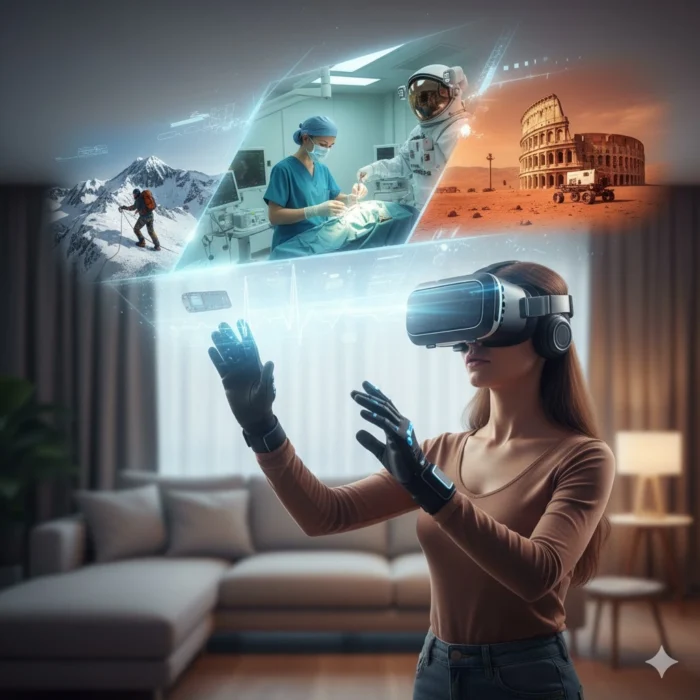
What is Virtual Reality? Virtual Reality (VR) is one of the most exciting and transformative technologies of the modern digital era. At its essence, VR refers to a computer generated simulation of a three dimensional environment that users can experience and interact with in real time. Unlike simply viewing media on a flat screen, VR immerses individuals in an alternate world, creating a strong sensation of presence the psychological impression that one is physically inside the simulated environment.
With the aid of VR headsets, motion controllers, haptic gloves, and sensors, users can do much more than watch. They can step into alternate realities, manipulate objects, and perform tasks that mimic real world experiences. Understanding what is virtual reality helps reveal why it’s not just a medium for entertainment but also a powerful tool for education, healthcare, training, design, and even therapy.
Imagine climbing Mount Everest without the risks, walking through the ruins of ancient Rome, performing intricate heart surgery as a medical student, or exploring the surface of Mars all from the comfort of your living room or classroom. This incredible capability perfectly defines what is virtual reality the power to merge imagination with technological precision, making VR a true revolution across multiple sectors.
History and Evolution of VR
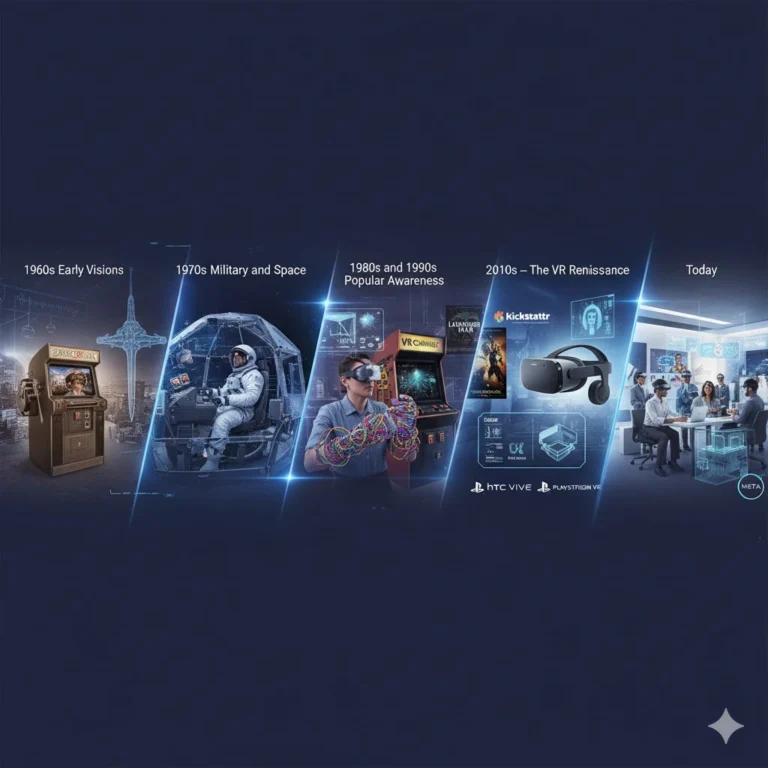
Although VR may seem like a recent invention, its conceptual roots date back many decades.
Enrich History: Include specific names like Jaron Lanier and key dates like the launch of the original consumer headsets (Rift, Vive) and major acquisitions (Facebook/Oculus).
1960s Early Visions
- Morton Heilig introduced the Sensorama, a mechanical arcade like machine that stimulated multiple senses through 3D visuals, vibrations, audio, and even scents.
- Ivan Sutherland, a computer scientist, conceptualized the “Ultimate Display,” imagining a room where computers could control matter. He went further to create the first head mounted display (HMD), known as the Sword of Damocles. Understanding what is virtual reality helps appreciate how its bulky design, though impractical at the time, laid the foundation for modern VR.
1970s Military and Space Exploration
- NASA and the U.S. Air Force adopted early VR simulators for astronaut and pilot training. Understanding what is virtual reality highlights how these experiments demonstrated VR’s potential for practical training while also exposing limitations such as high costs and low processing power.
1980s and 1990s Popular Awareness
- Jaron Lanier, founder of VPL Research, popularized the term “virtual reality.” His company developed early VR gloves and goggles.
- Arcade centers introduced primitive VR gaming machines, sparking curiosity.
- Movies like The Lawnmower Man fueled public fascination but also exaggerated expectations. Understanding what is virtual reality helps explain why, despite the hype, poor graphics, nausea inducing headsets, and high costs kept VR from achieving mainstream success.
2010s – The VR Renaissance
- In 2012, Palmer Luckey launched the Oculus Rift prototype on Kickstarter, sparking renewed interest. Understanding what is virtual reality helps explain why soon after, major players like HTC Vive, Sony PlayStation VR, and Meta (formerly Facebook) entered the field.
- VR technology improved drastically with higher resolution displays, motion tracking, and wireless connectivity, making it accessible to consumers.
Today
VR has moved far beyond being a gaming novelty. Understanding what is virtual reality shows why it is now a serious tool in medicine, engineering, defense, education, and business collaboration. With the rise of the metaverse, VR is evolving into a central pillar of digital transformation.
4 Core Elements of Virtual Reality (VR)
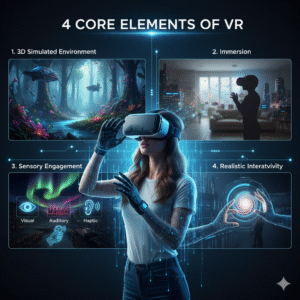
The experience of Virtual Reality is built upon these four interconnected elements:
1. 3D Simulated Environment
- This is the foundation; a world that is computer generated created with depth and spatial dimensions.
- It performs as the digital world that completely replace the user’s view of looking the real world.
- The environment is a purely imaginative setting and can replicate the real world.
2. Immersion
- it’s psychologically percepts like being physically available inside the world
- high quality visuals and wide field of view helps achieving the virtual reality which blocks out the real world.
- Low latency (minimal delay between movement and visual update) is crucial to maintain this feeling of “being there.”
3. Sensory Engagement
- to make virtual world feel more believable the strategic use of sensory inputs are used.
- Visual: Provided by the Head Mounted Display (HMD).
- Auditory: Spatial 3D sound that keeps changes according to the position and orientation of the user.
- Haptic: Feedback (like vibrations or resistance) that helps make it more realistic through the controllers or suits that stimulates the sense of touch.
4. Realistic Interactivity
- The user’s ability to act upon the virtual environment and have it respond in a natural, expected manner.
- it takes the accurate tracking movements of hands and head
- Allows the user to manipulate virtual objects (e.g., picking up, throwing) which must follow the simulated physics of the world.
Understanding what is virtual reality is important in today’s digital world, as immersive technology is rapidly changing the way people learn, work, and experience entertainment.
Types and Forms of Virtual Reality
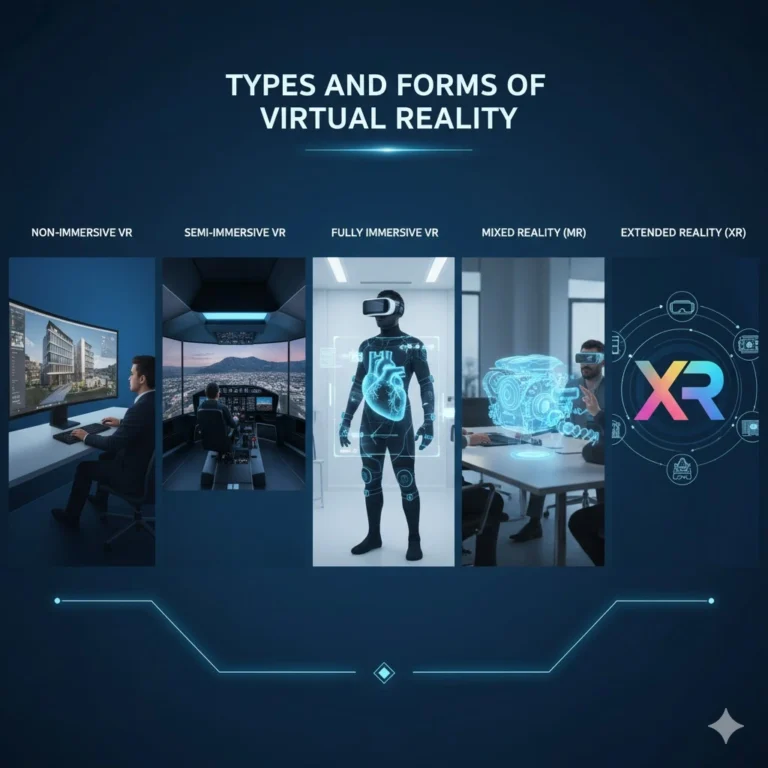
VR is not a single technology it exists in multiple forms depending on the degree of immersion:
- Non Immersive VR : Users interact with a virtual environment via a computer screen, keyboard, or mouse. Understanding what is virtual reality helps illustrate how examples like simulation games such as The Sims or architectural visualization software provide immersive, interactive experiences.
- Semi Immersive VR : Uses large projection screens or curved displays, such as flight simulators, to create a sense of immersion while still allowing users to remain aware of their surroundings.
- Fully Immersive VR : This approach relies on head mounted displays, motion sensors, and haptic devices to provide complete immersion. Understanding what is virtual reality explains why this is the most common form seen in gaming, training, and medical simulations.
- Mixed Reality (MR) : Blends the real and virtual worlds, allowing physical and digital objects to interact. For instance, a person can manipulate a digital 3D model that appears anchored to a real world table.
- Extended Reality (XR) : The umbrella term that encompasses VR, AR (augmented reality), and MR. Understanding what is virtual reality helps clarify how it represents the entire spectrum of immersive technologies.
VR vs. AR vs. MR
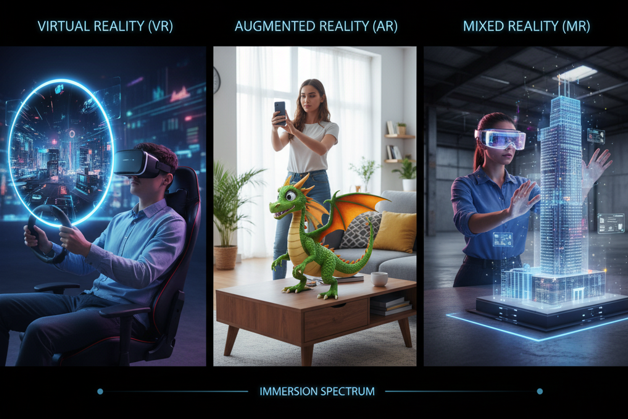
1. Virtual Reality (VR) – The Digital Escape
- Focus: stimulated digital environment that completely replaces the real world.
- Experience: the user is so dissolved in it that he is unable to interact with their physical surroundings.
- Motto: “You have the reached the new world.”
- Hardware: Requires an opaque headset that blocks all external light that are interfering.
- Use Cases: Training simulations (pilots, surgeons), highly immersive video games, and virtual cinema experiences.
2. Augmented Reality (AR) – Digital Overlay
- Focus: Enhancing the real world by overlaying digital information, graphics, or sounds.
- Experience: The real world remains the central view. Digital elements simply appear on top of the reality, but don’t physically interact with it.
- Motto: “You are still here, but with digital enhancements.”
- Hardware: that requires your smartphone camera and smart glasses.
- Use Cases: Trying on virtual glasses, placing virtual furniture in a room, and navigation with on screen directions.
3. Mixed Reality (MR) – Interacting Worlds
- Focus: A true merging of the physical and digital worlds, allowing them to interact and co exist seamlessly.
- Experience: Digital objects are anchored to the real environment and can be manipulated by or affect physical objects (e.g., a virtual character sitting on your real couch).
- Motto: “Digital and real objects co exist and react to one another.”
- Hardware: Requires advanced transparent headsets with sophisticated sensors (LiDAR, cameras).
- Use Cases: Engineers collaborating on a 3D model overlaid onto a real conference table, or technicians getting virtual instructions anchored directly onto a physical machine they are repairing.
Glossary/Framework Update: Update terminology to use “Spatial Computing” (as popularized by Apple) or “XR” to align with current industry discourse. Clearly define Mixed Reality (MR).
To understand what is virtual reality, it is necessary to explore how modern technology creates immersive environments that feel almost identical to real life.
How Virtual Reality Works
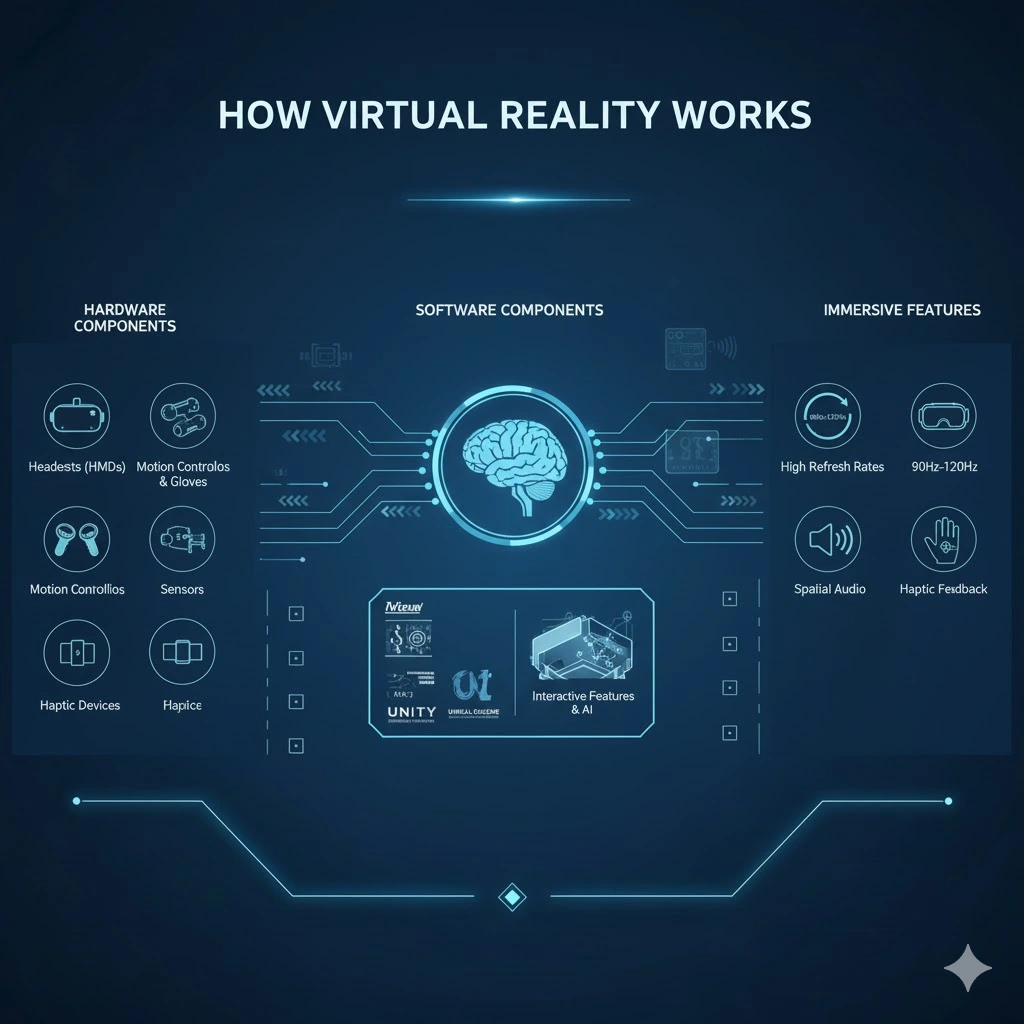
At the heart of VR is the careful synchronization of hardware and software to trick the human brain into accepting a digital world as real.
Hardware Components:
- Headsets (HMDs): Provide stereoscopic 3D visuals, displaying separate images for each eye to create depth.
- Motion Controllers & Gloves: Enable hand tracking, gestures, and object manipulation.
- Sensors & Cameras: Track body movements and head orientation for accurate positioning.
- Haptic Devices: Deliver physical sensations, such as vibration or pressure, enhancing realism.
Detailed Hardware Table: Create a regularly updated table summarizing the key specs of top standalone and PC VR headsets. This helps users make purchase decisions. Mention Pancake/Fresnel Lenses: Explain modern lens technology for visual quality.
Software Components:
- VR environments are built using powerful engines such as Unity and Unreal Engine.
- Developers integrate physics engines, sound design, AI driven characters, and interactive features.
Immersive Features:
- High Refresh Rates (90Hz–120Hz): Reduce motion sickness and ensure smooth experiences.
- Spatial Audio: Makes sounds appear as if they originate from specific directions in 3D space.
- Haptic Feedback: Adds tactile sensations for deeper immersion.
When these systems operate seamlessly, the brain suspends disbelief and users feel transported into another reality.
When studying what is virtual reality, we can see how advanced hardware and software work together to create highly realistic digital experiences.
Key Features: Immersion, Presence & Realism
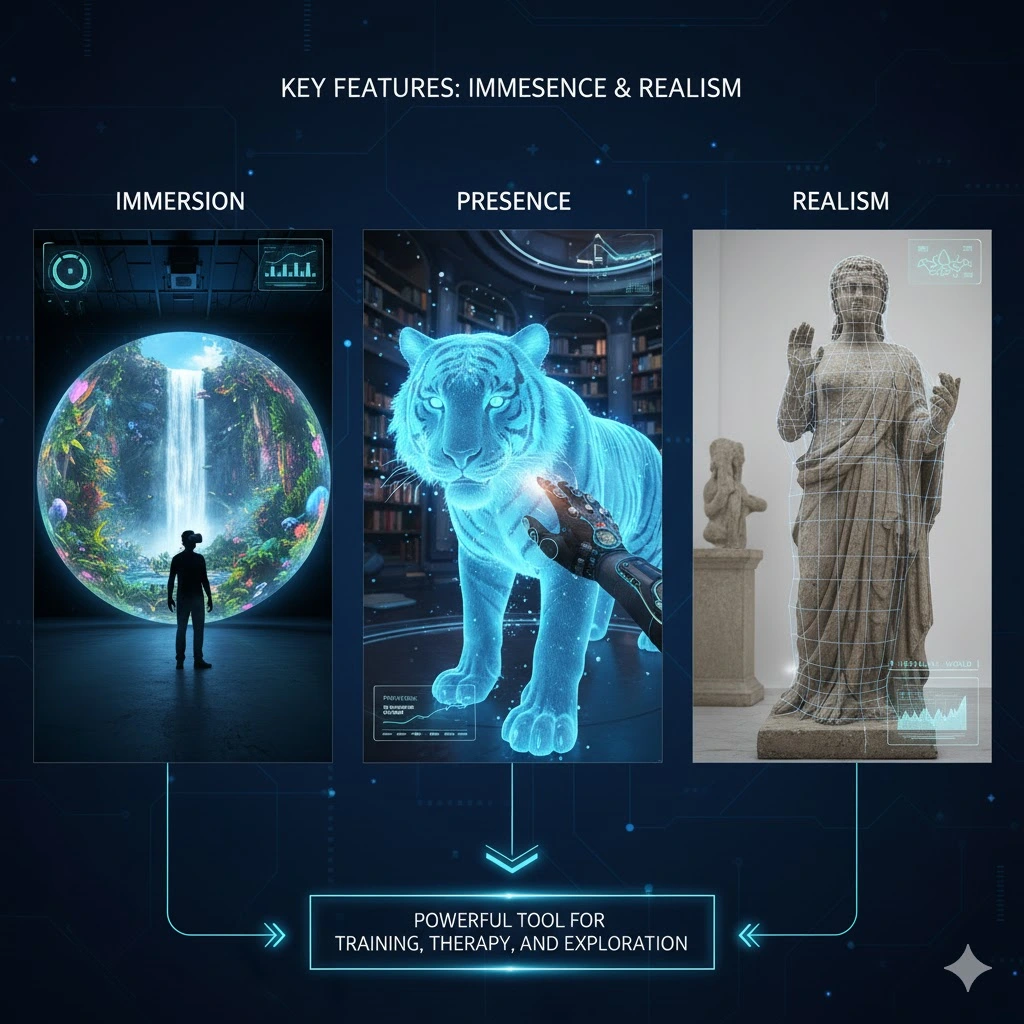
A successful VR experience relies on three defining features:
- Immersion: The extent to which a user feels enveloped by the virtual environment.
- Presence: The psychological sensation of “being there,” even though one knows it’s simulated.
- Realism: The authenticity of visuals, sounds, physics, and interactions.
These elements combine to create not just entertainment but a powerful tool for training, therapy, and exploration.
Applications / Use Cases of VR
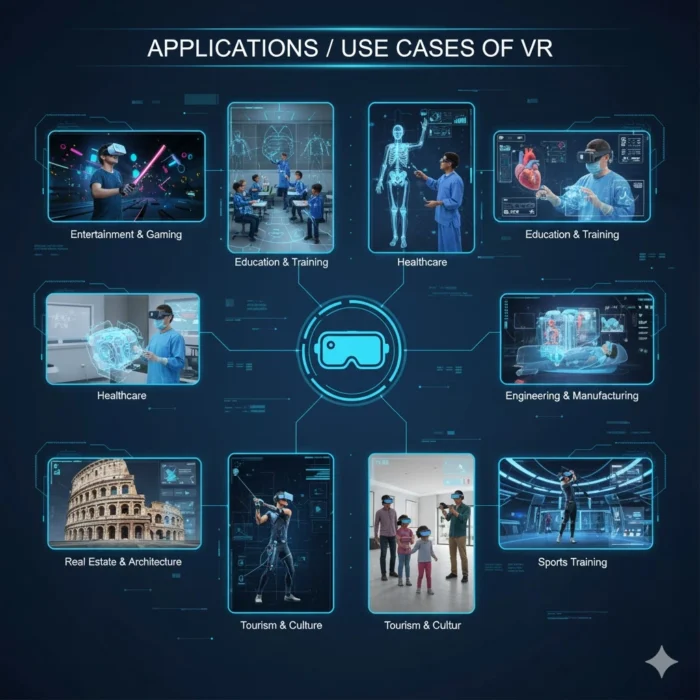
VR’s versatility has made it valuable across many industries:
- Entertainment & Gaming: Games like Beat Saber and Half Life: Alyx provide unique, interactive experiences. Understanding what is virtual reality also helps explain why VR concerts and theaters are becoming increasingly popular.
- Education & Training: Virtual classrooms allow students to explore history, anatomy, and science in interactive environments.
- Healthcare: VR is used for surgical simulations, pain management, and therapy for phobias.
- Engineering & Manufacturing: Engineers visualize prototypes in VR before building physical models.
- Real Estate & Architecture: Clients can virtually tour houses or preview building designs.
- Tourism & Culture: Virtual museum tours and historical reconstructions bring learning to life.
- Sports Training: Athletes practice strategies, refine movements, and reduce injury risks using VR simulations.
VR Experiences
The development of Virtual Reality (VR) experiences relies on powerful tools and unified standards to ensure high quality and broad platform compatibility. The landscape is currently dominated by two major game engines and is being made more accessible by key open standards.
Learning what is virtual reality also helps us understand why it is widely used in gaming, education, healthcare, training, and many other industries.
Dominant Game Engines
The vast majority of professional VR content is created using one of two primary development platforms:
- Unity:
- Strengths: Known for its accessibility, gentle learning curve, and extensive cross platform support (including mobile VR headsets like Meta Quest). It has a massive developer community, a huge asset store, and primarily uses the more beginner friendly C# scripting language.
- Best For: Independent developers, smaller teams, mobile VR, corporate training, architectural visualization, and projects prioritizing broad device compatibility.
- Unreal Engine (UE):
- Strengths: Renowned for its cutting edge graphics, photorealistic rendering capabilities, and advanced visual features (like Lumen and Nanite in UE5). It uses the powerful C++ language alongside its visual scripting system, Blueprints.
- Best For: High fidelity, graphically intense experiences (often called “AAA” quality), PC based VR, film production, and developers with experience seeking the most realistic visuals.
VR in Emerging / Non Traditional Fields
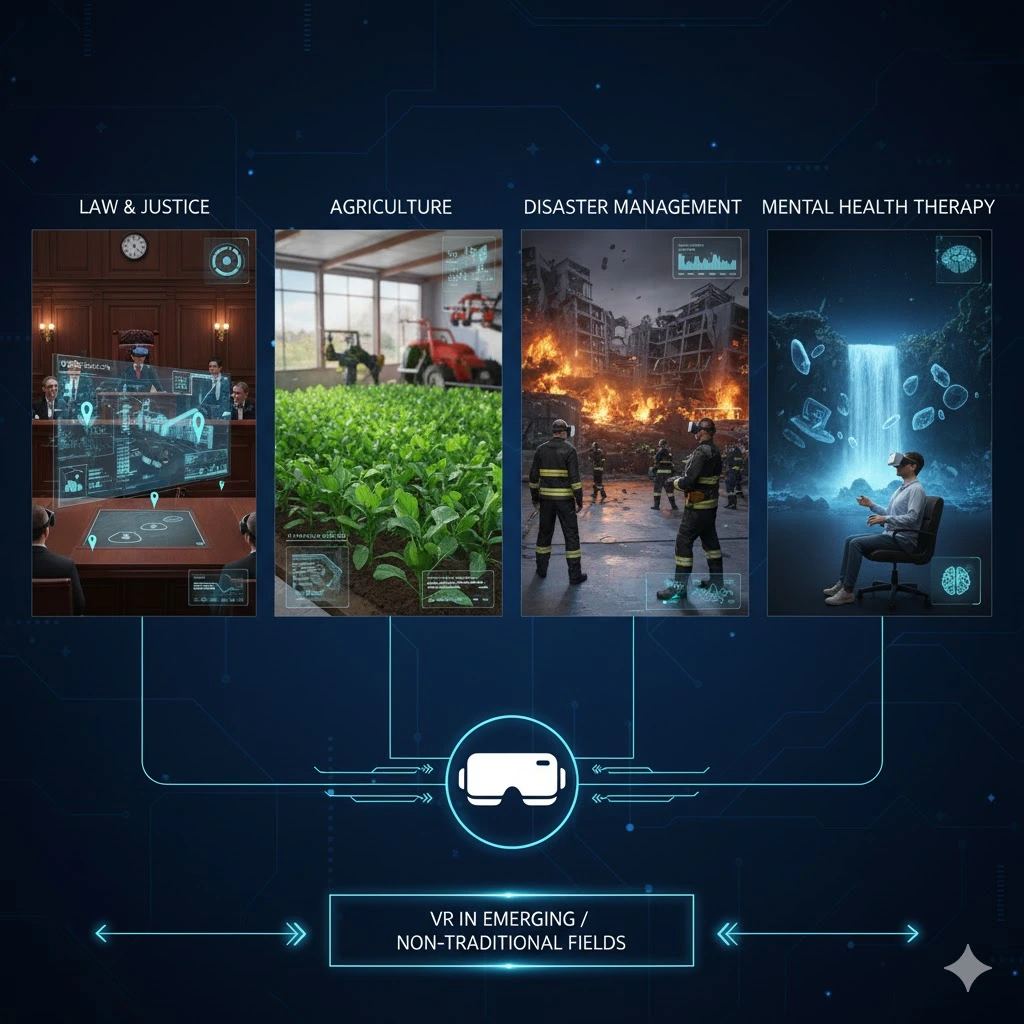
VR is expanding into unconventional areas:
- Law & Justice: Courts use VR reconstructions of crime scenes to present evidence.
- Agriculture: Farmers practice crop management and machinery handling through VR simulations.
- Disaster Management: Emergency responders train for earthquakes, fires, and floods in realistic but safe VR environments.
- Mental Health Therapy: VR meditation and relaxation programs help reduce anxiety and stress.
The concept of what is virtual reality continues to evolve as new innovations make immersive experiences more realistic, accessible, and powerful.
Content Creation & Tools for VR
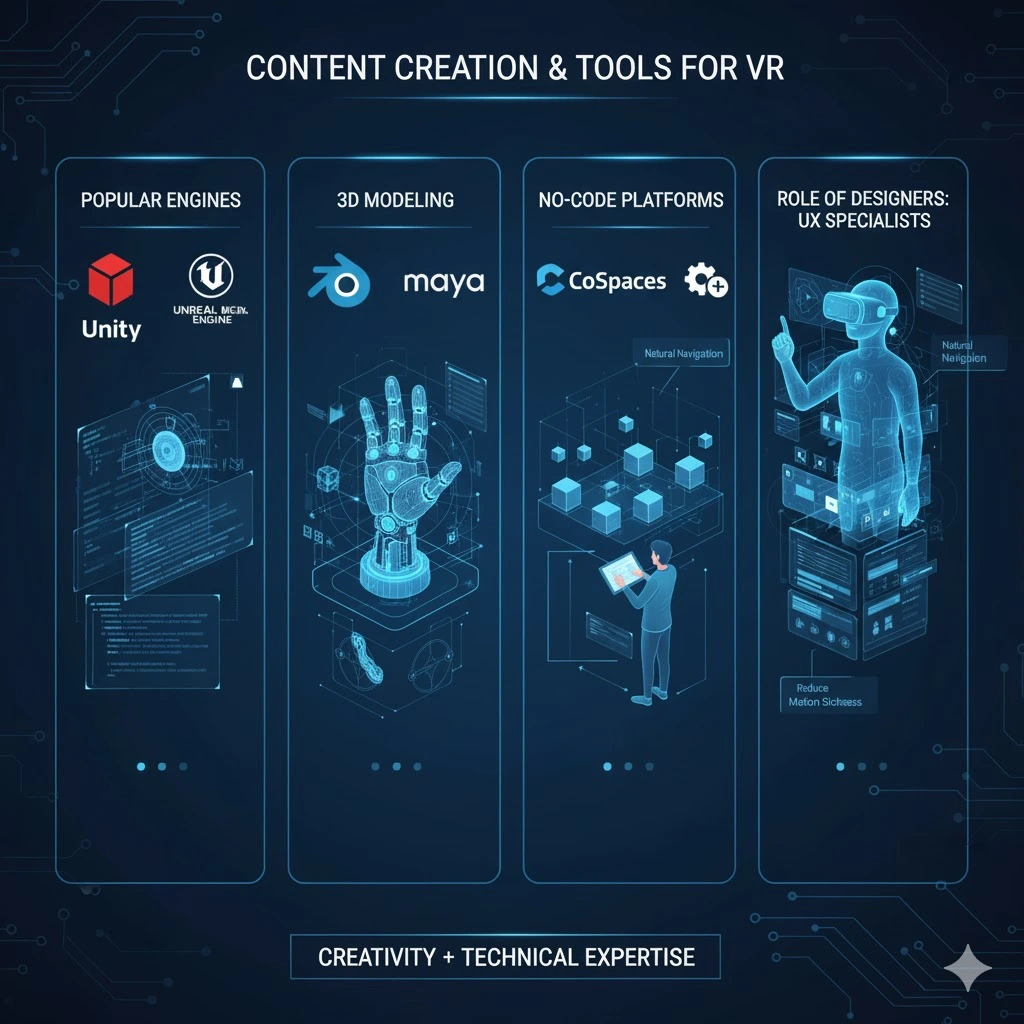
Developing VR requires both creativity and technical expertise.
- Popular Engines: Unity and Unreal Engine dominate VR development.
- 3D Modeling: Tools like Blender and Maya create lifelike objects.
- No Code Platforms: CoSpaces and VR Builder allow non programmers to design experiences.
- Role of Designers: UX specialists ensure natural navigation, reducing confusion and motion sickness.
Cost, Access & Affordability

One of the main barriers to VR adoption is cost.
- High End Devices: HTC Vive Pro, Valve Index, and Varjo deliver cutting edge quality but require expensive PCs.
- Affordable Options: Meta Quest 3 and Google Cardboard make VR accessible to casual users.
- Digital Divide: Wealthier nations adopt VR faster, while developing regions face challenges in affordability and infrastructure.
Challenges & Limitations
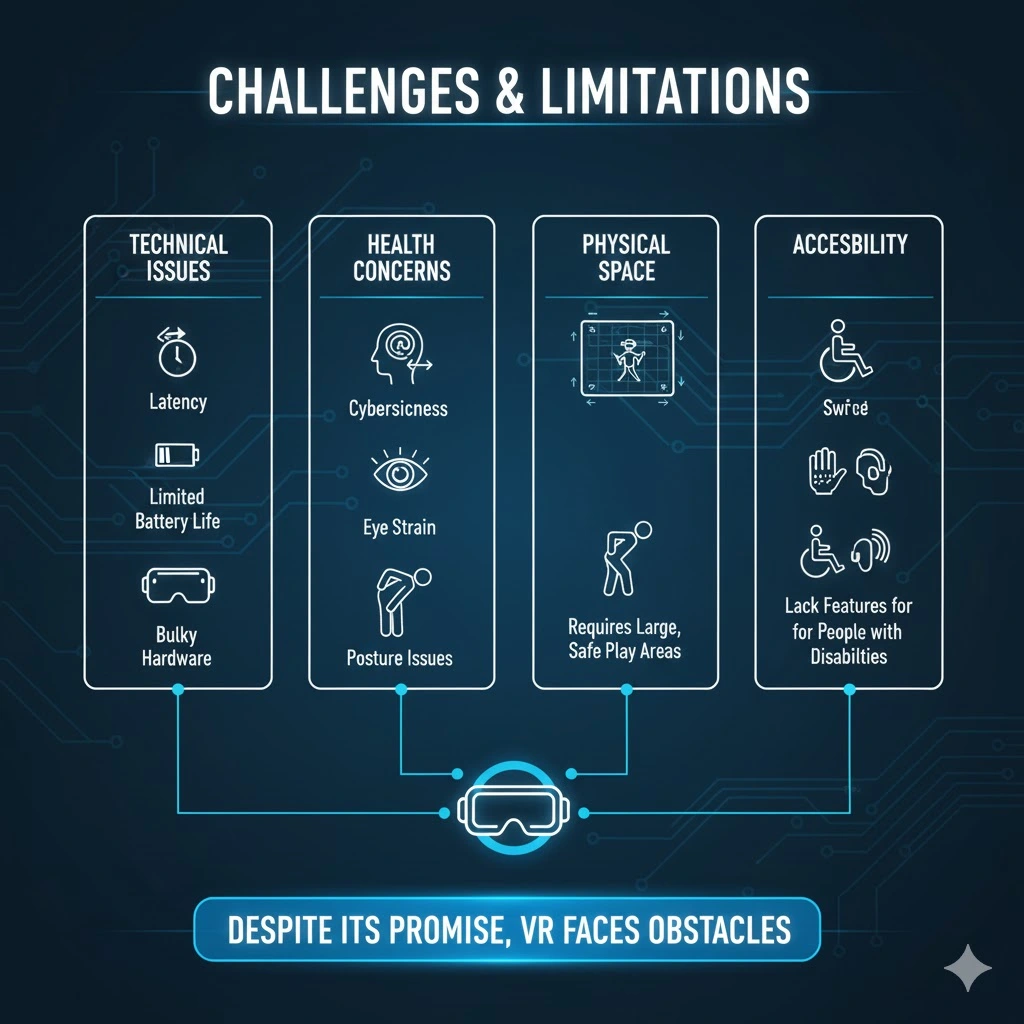
Despite its promise, VR faces obstacles:
- Technical Issues: Latency, limited battery life, and bulky hardware hinder comfort.
- Health Concerns: Cybersickness, eye strain, and posture issues affect some users.
- Physical Space: VR often requires large, safe play areas.
- Accessibility: Many systems lack features for people with disabilities.
To fully understand what is virtual reality, it is helpful to look at its history and how it developed from simple simulations to advanced immersive systems.
Safety and Ethical Considerations in Virtual Reality
As VR technology becomes more sophisticated and immersive, it introduces new challenges related to user safety, well being, and data privacy. A “complete guide” must address these concerns transparently.
1. Minimizing Motion Sickness (Simulated Illness)
VR motion sickness (often called cybersickness) occurs when there is a mismatch between what your eyes see (motion in the virtual world) and what your inner ear senses (your body remaining stationary).
2. Privacy and Biometric Data Concerns
Modern VR headsets collect significantly more personal data than smartphones or computers, raising substantial privacy concerns.
- Biometric Data Collection: Advanced headsets (like the Apple Vision Pro and Meta Quest Pro) feature:
- Eye Tracking: Collects data on where you look, how long you look, and your pupil dilation. This reveals deep insights into your cognitive state, interests, attention, and emotional response.
- Face and Body Tracking: Captures real time facial expressions, gestures, and body language.
- Unique Identity Fingerprinting: The combination of eye movements, head shape, and movement patterns is unique to every user, making it possible to create a “biometric fingerprint” that could be linked back to a real identity.
- The Problem: This highly sensitive data can be used for targeted advertising, assessing mental state, or potentially compromising user privacy if leaked or sold.
Ethical Guidelines and User Responsibility:
- Transparency: Users should demand clear, understandable privacy policies from hardware and software vendors regarding exactly what biometric data is collected, how it is stored, and who it is shared with.
- Default Privacy Settings: Developers should design software with privacy by default, making users actively opt in to features that collect sensitive data.
- Online Safety: In social VR spaces (like VRChat or Meta Horizon Worlds), platforms must provide robust safety tools, such as:
- Personal Boundary Systems: A virtual force field that prevents other avatars from coming too close.
- Mute, Block, and Reporting: Easy, instant access tools for dealing with harassment or inappropriate behavior.
Knowing what is virtual reality is essential in the modern technology era, because this innovation is expected to play a major role in the future of digital interaction.
Ethics, Privacy & Data Security
As VR expands, ethical challenges grow:
- Data Ownership: Who controls biometric data like eye movements or gestures?
- Content Regulation: Should all types of experiences be allowed, even violent or explicit ones?
- Privacy: VR headsets can track sensitive physical behaviors, raising privacy concerns.
Governments and tech organizations are working to create regulations to address these issues responsibly.
What is virtual reality is a common question today, as more people become interested in immersive technologies that allow them to experience digital worlds in real time.
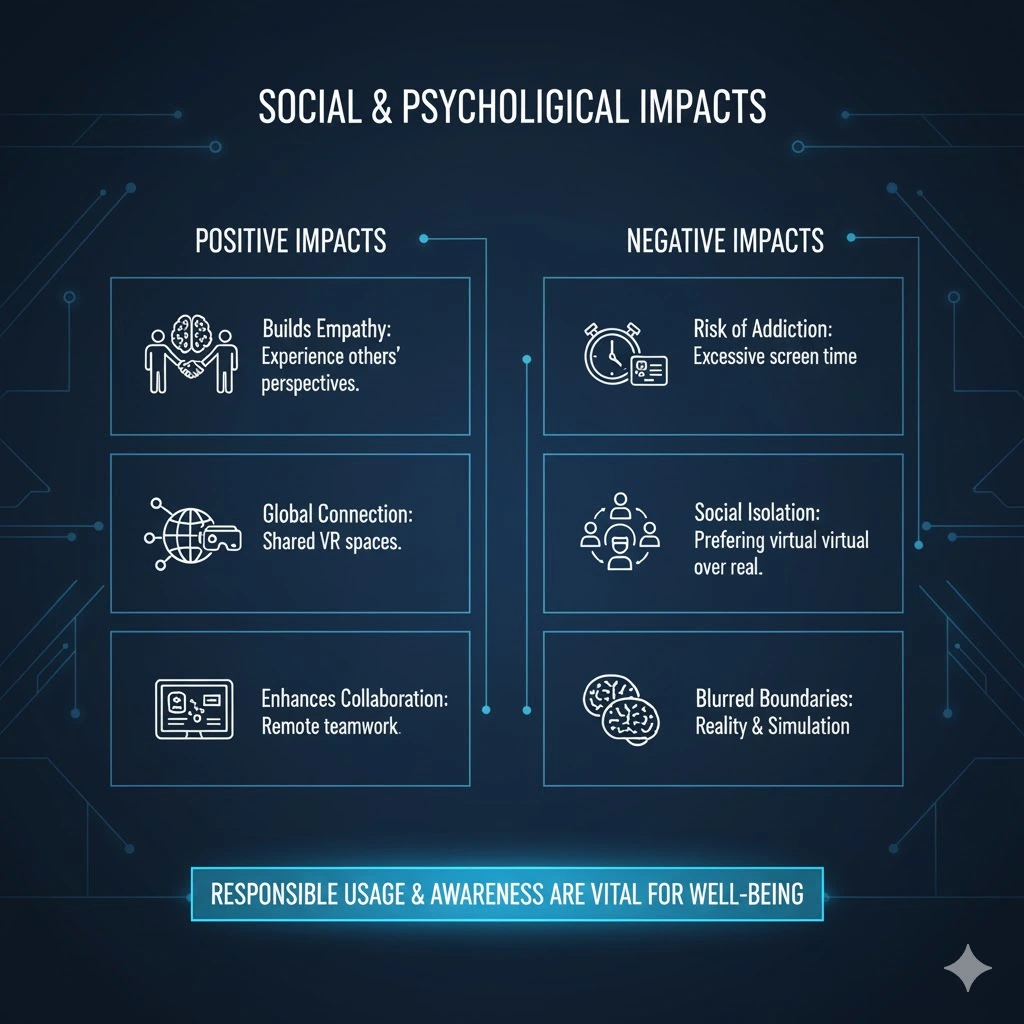
Social & Psychological Impacts
VR impacts human behavior positively and negatively:
- Positive:
- Builds empathy by letting users experience others’ perspectives. ○ Connects people globally through shared VR spaces.
- Enhances remote collaboration and teamwork.
- Negative:
- Risk of addiction and excessive screen time.
- Social isolation when users prefer virtual interactions over real ones. ○ Blurred boundaries between reality and simulation.
Responsible usage and awareness are vital for well being.
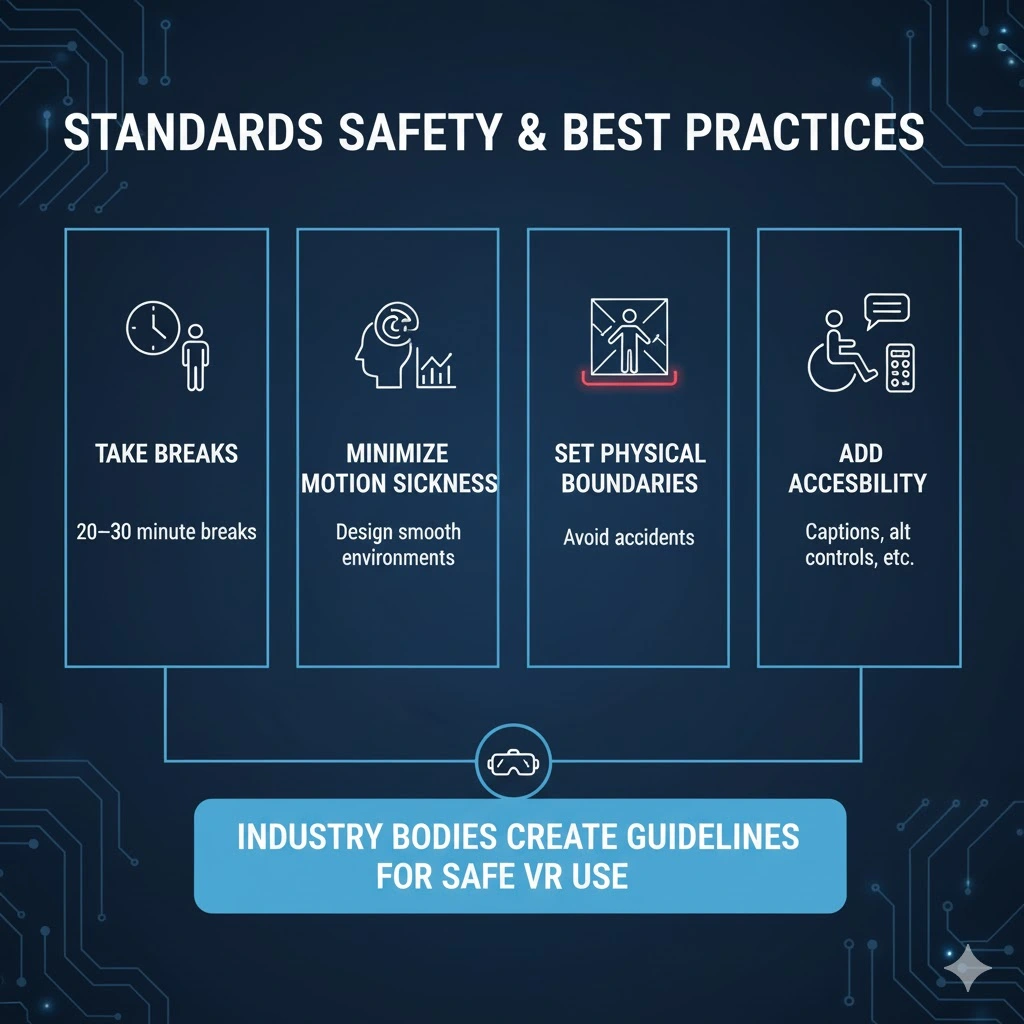
Standards, Safety & Best Practices
Safe VR use requires guidelines:
- Take 20–30 minute breaks during sessions.
- Design environments that minimize motion sickness.
- Set physical boundaries to avoid accidents.
- Add accessibility features like captions or alternative controls.
Industry bodies such as the XR Association are creating standards for ethical and safe VR use.
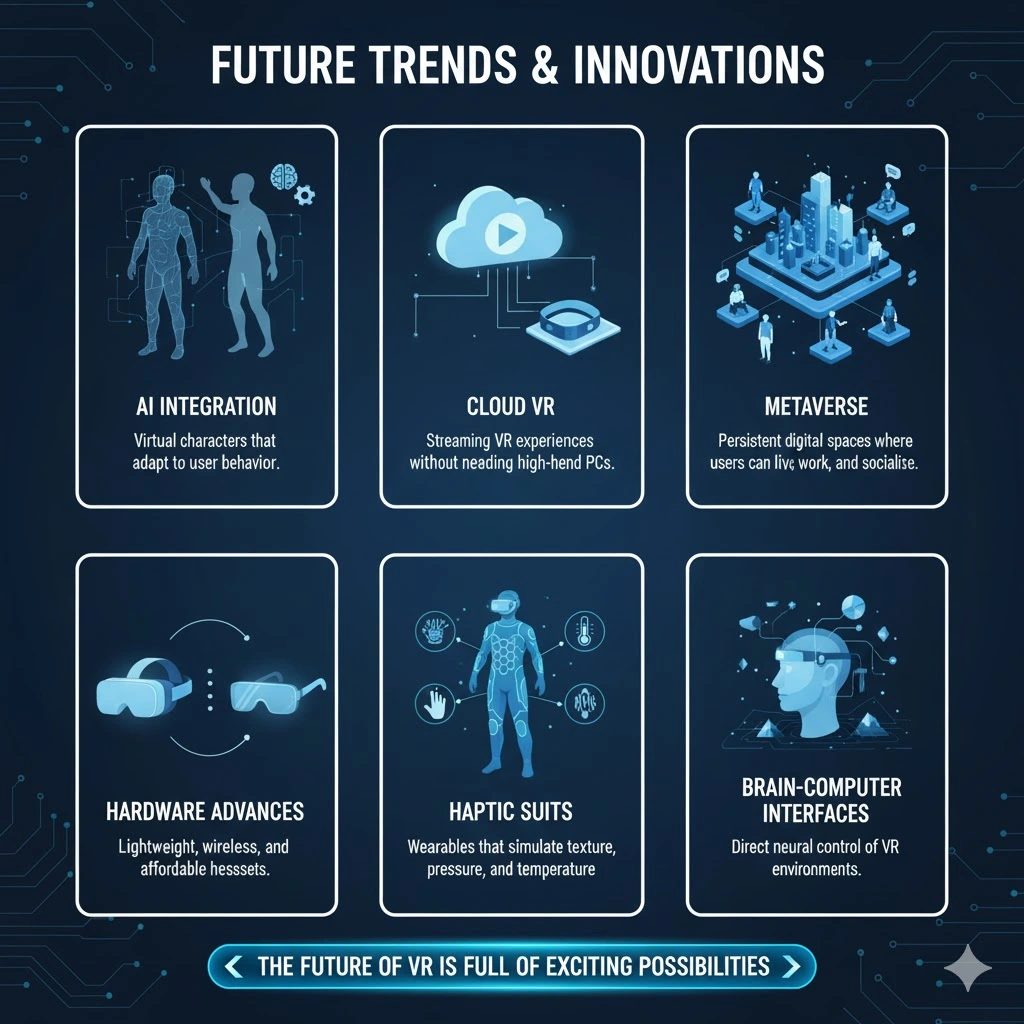
Future Trends & Innovations
The future of VR is full of exciting possibilities:
- AI Integration: Virtual characters that adapt to user behavior.
- Cloud VR: Streaming VR experiences without needing high end PCs.
- Metaverse: Persistent digital spaces where users can live, work, and socialize.
- Hardware Advances: Lightweight, wireless, and affordable headsets.
- Haptic Suits: Wearables that simulate texture, pressure, and temperature.
- Brain Computer Interfaces: Direct neural control of VR environments.
Understanding what is virtual reality gives us insight into how immersive technology is transforming communication, entertainment, education, and business worldwide.
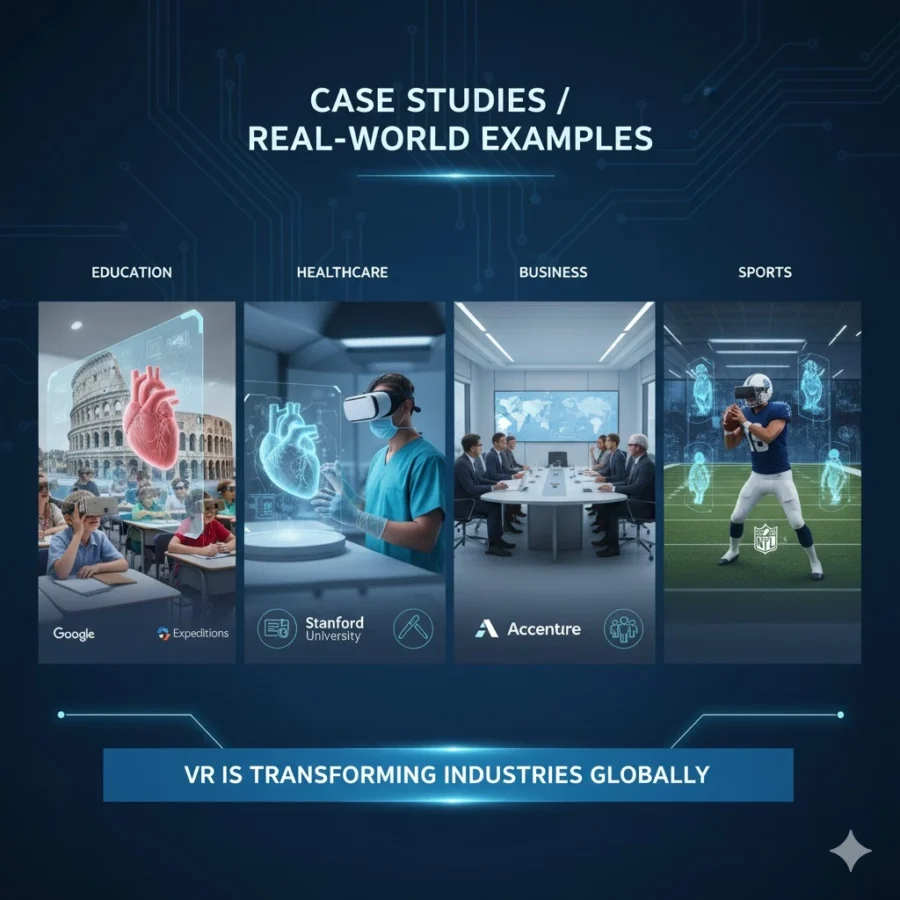
Case Studies / Real World Examples
- Education: Google Expeditions enabled millions of students to explore historical sites virtually.
- Healthcare: Stanford University trains surgeons with VR before real life operations.
- Business: Accenture uses VR for employee collaboration across continents.
- Sports: The NFL trains quarterbacks using VR simulations to read defenses.
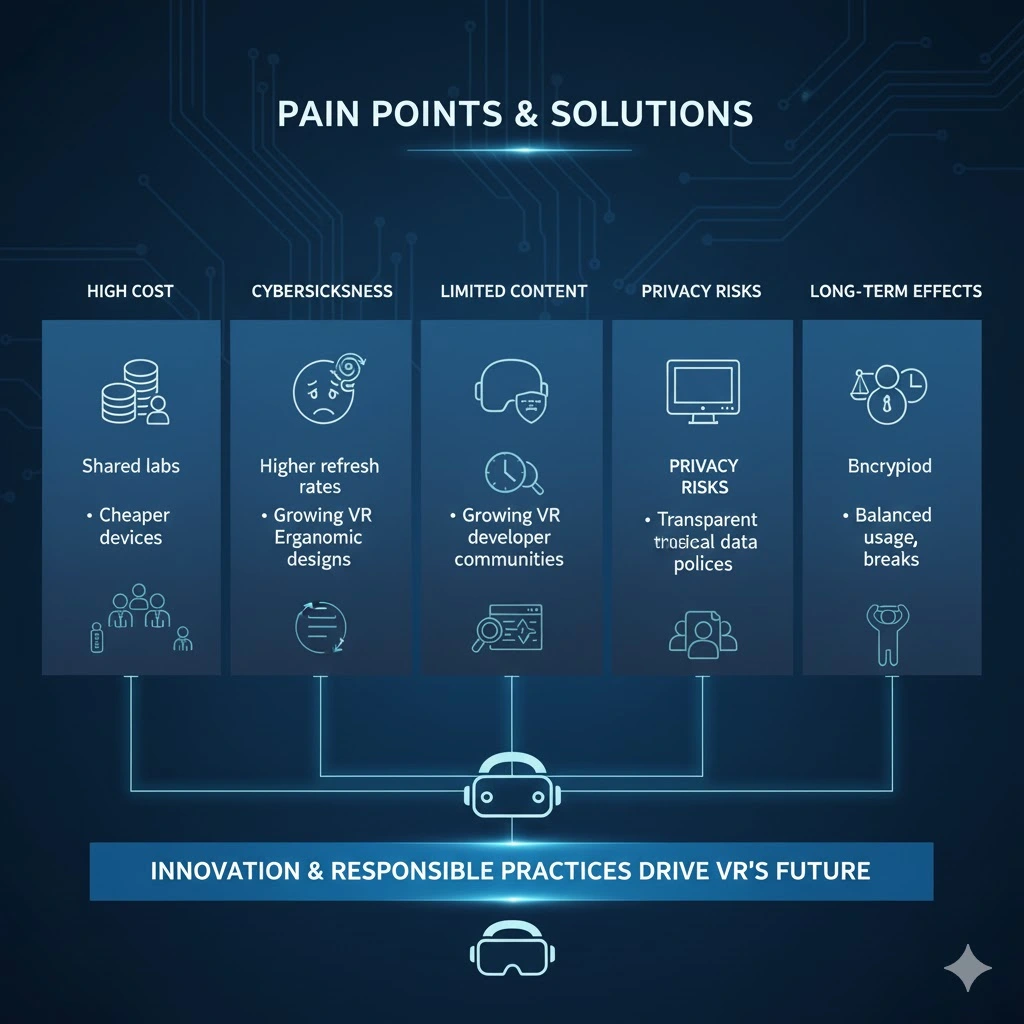
Pain Points & Solutions
Challenges remain, but solutions are emerging:
- High Cost: Shared labs, rentals, and cheaper devices increase accessibility.
- Cybersickness: Higher refresh rates and ergonomic designs reduce nausea.
- Limited Content: Growing VR developer communities are expanding available experiences.
- Privacy Risks: Encryption and transparent data policies are being developed.
- Long Term Effects: Balanced usage and physical breaks mitigate health concerns.
Conclusion
वर्चुअल रियलिटी आने वाले भविष्य में एक ऐसी बहुत महत्वपूर्ण टेक्नोलॉजी है जो आगे चल के बोहोत काम आने वाली है। पूरी दुनिया इसका इस्तमाल हर फील्ड में करेगी और इसके फायदे लेगी ये लोगो की काल्पनिकता को हकीकत में बदलेग। आगे चल के जो भी इस टेक्नोलॉजी का इस्तेमाल नहीं करेगा वह पीछे रह जाएग। आने वाले समय में इसका उपयोग हेल्थकेयर, एजुकेशन, आर्किटेक्चर जैसी चीज़ो में फ्यूचर को बदलने के लिए इस्तेमाल किया जाएगा और हमारे याद करने और सोचने के तोर तरीको को भी चेंज करेग। इसलिए जितना जल्दी हो सके हमें इसके तरफ अपना रुझान लाना चाहिए और इसके लाभ उठाने चाहिए।
Virtual Reality has journeyed from a science fiction dream to a practical, transformative technology. For many, understanding what is virtual reality means exploring how it shapes entertainment, education, medicine, business, and even social interaction just as Smart home devices are transforming the way people live and connect with technology. While challenges such as high costs, health risks, and ethical dilemmas remain, the pace of innovation ensures VR will only become more accessible and impactful.
The future of VR lies in merging imagination with reality, enabling experiences once thought impossible. As hardware evolves, content expands, and society adapts, VR is set to redefine how humans connect, learn, and live in the 21st century. Understanding what is virtual reality becomes essential as this technology continues to influence multiple industries. Digital marketing agencies like Shark Mondo are also exploring how virtual environments can revolutionize brand engagement and immersive marketing experiences.