Table of Contents
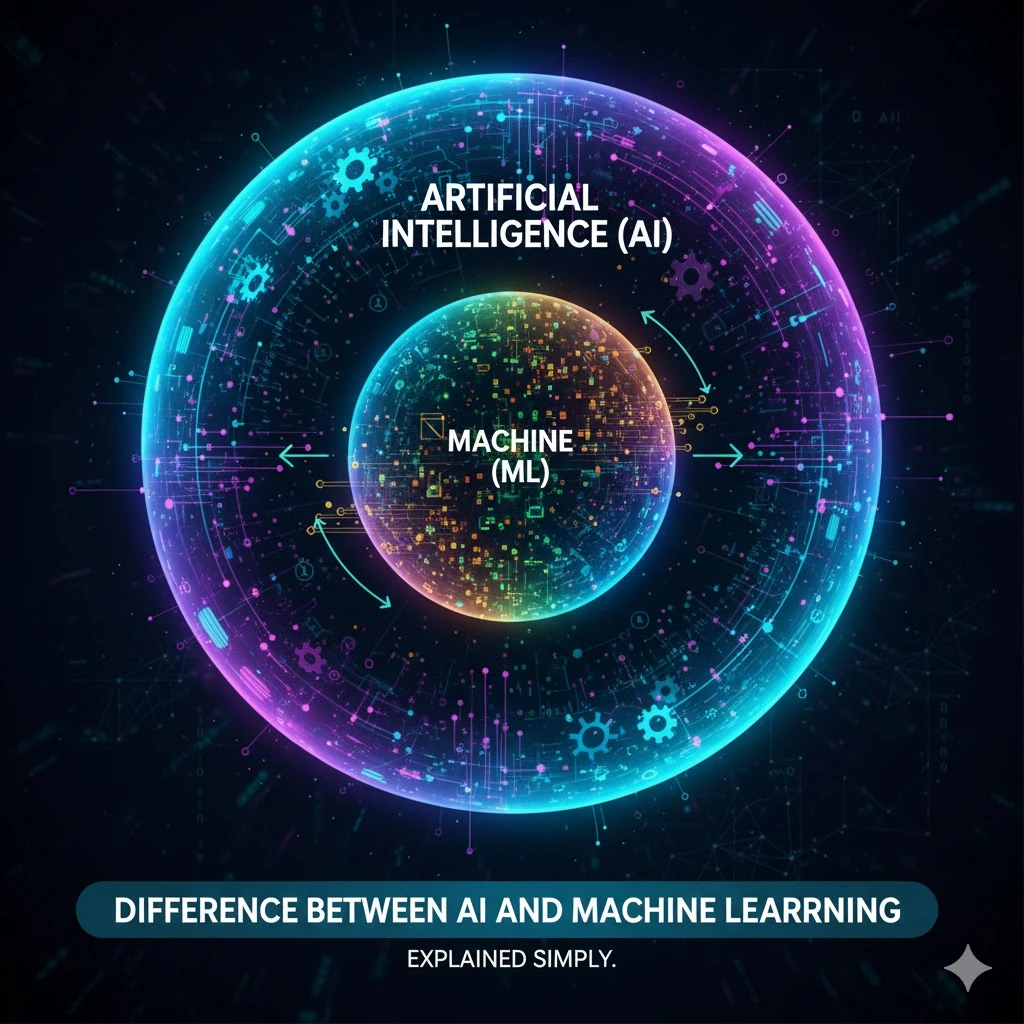
Difference Between AI and Machine Learning Explained Simply
History Of Artificial Intelligence (AI) And Machine Learning (ML)
● Artificial Intelligence
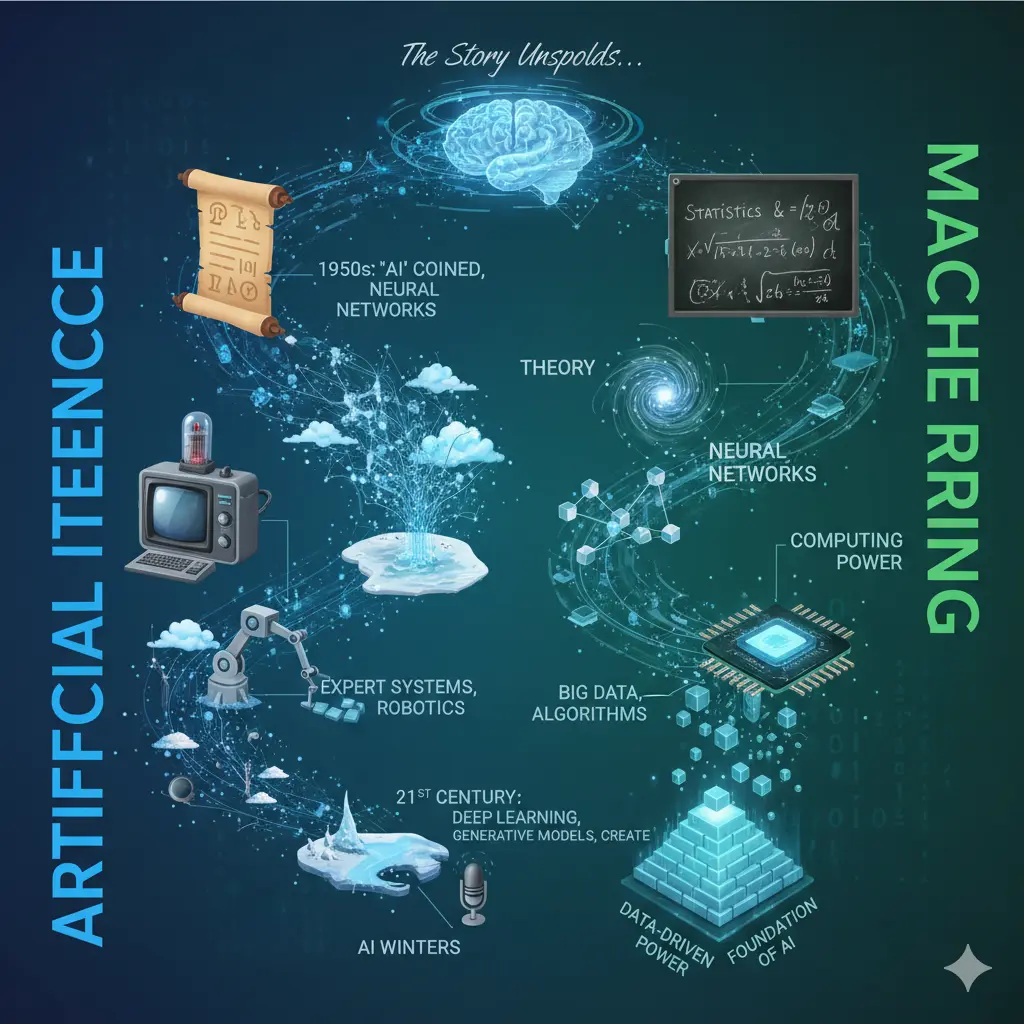
The history of artificial intelligence (AI) is long, very long. It spans centuries of thought, debate, and wild imagination. Philosophers continued to ponder if probability and logic could be turned into machines. The dream seemed far away. Then came the huge but promising spark computers in the 1950s.. Small and awkward, neural networks emerged and began to take root. The term “Artificial Intelligence” was created and has remained in use. As time went on, researchers started examining the distinctions between AI and machine learning, realising that AI embodies the more general idea of intelligent systems, whereas machine learning concentrates on teaching machines to learn from data.
Expert systems emerged as years went by. Robots acquired the ability to move. Even machines attempted, though not always successfully, to respond in human language. There were also winters, when AI appeared frozen and nearly lifeless. It never actually stopped breathing, though. Then the twenty-first century came, and machine learning took off. Machines can now see, hear, and even sense thanks to deep learning. Generative models have advanced to the point where they produce voices, visuals, and stories in addition to calculations. Perhaps too human, yet almost human. The distinction between AI and machine learning grew more evident as technology advanced, demonstrating how AI is the more comprehensive foundation for intelligence while machine learning uses data and algorithms to drive it.
● Machine Learning
Machine learning’s (ML) past is like a story. The foundation was solid but insufficient when it came to statistics and reasoning. Theory then entered the picture, providing it structure and weight. Neural networks appeared, a little unreliable but promising. After algorithms advanced the process, data massive, disorganised, limitless data arrived. All of a sudden, machines began to learn in ways that humans never would have imagined. Though it changed everything, computing power continued to increase relatively silently. What started off as symbolic ploys gradually evolved into actual data-driven power.
Today, these models don’t just support AI they form the foundation of it. Understanding the difference between AI and machine learning highlights how AI is the broader goal of intelligent systems, while machine learning provides the practical methods that make AI’s vision achievable. Well, the story is still unfolding.
What Is Artificial Intelligence (AI) And Machine Learning (ML)
● Artificial Intelligence
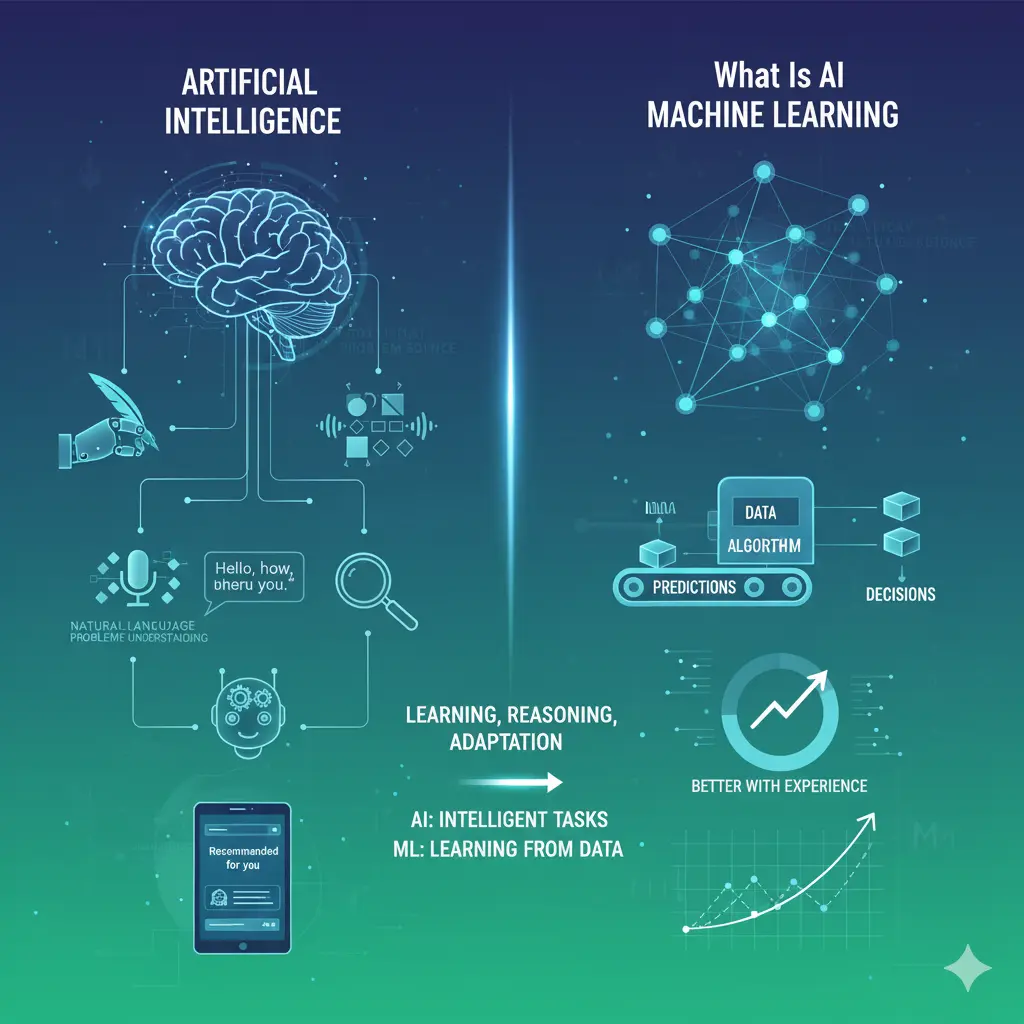
The goal of artificial intelligence, a subfield of computer science, is to create machines and systems that can learn, reason, make decisions, comprehend natural language, and solve problems tasks that frequently need human intelligence. AI systems mimic tasks including making suggestions, comprehending speech, evaluating photos, and producing new material using algorithms, data, and computerised models. Knowing the distinction between AI and machine learning makes it clearer that AI is the overarching objective of intelligent behaviour, whilst machine learning is one of the essential techniques that enables these systems to learn from data and get better over time.
● Machine Learning
Machine learning is a branch of artificial intelligence that aims at training computers to learn from data and gain better performance on tasks through experience rather than being specifically programmed for every particular task. Machine learning algorithms scan huge amounts of data to recognize patterns, make predictions or decisions, and get better over time by being exposed to increasing data. Understanding the difference between AI and machine learning helps clarify that while AI is the broader concept of creating intelligent systems, machine learning is one of its key approaches that enables machines to learn and adapt automatically.
Common Dif erences Between Artificial Intelligence (AI) And Machine Learning (ML)
| Aspect | Artificial Intelligence | Machine Learning |
| Definition | The broad field focused on creating systems that simulate human intelligence, capable of reasoning, problem solving and decision making. | Subset of AI that enables machines to learn from data and improve performance seperately. |
| Scope | Enclose many techniques like rule based systems, expert systems, robotics, neural networks, and ML itself. | Primarily focuses on algorithms and statistical models for pattern recognition and prediction |
| Objective | To automate complex human tasks efficiently, including cognition and perception | To analyze large data sets to identify patterns and make predictions or classifications |
| Methods | Includes a variety such as logic, rule systems, search algorithms, neural networks | Mainly involves supervised, unsupervised, and reinforcement learning methods |
| Key Implementation | Early chess programs, expert systems, symbolic reasoning, rule-based logic | Recommendation engines, image recognition, predictive analytics, spam detection |
Parallels Between Artificial Intelligence( AI) And Machine literacy( ML)
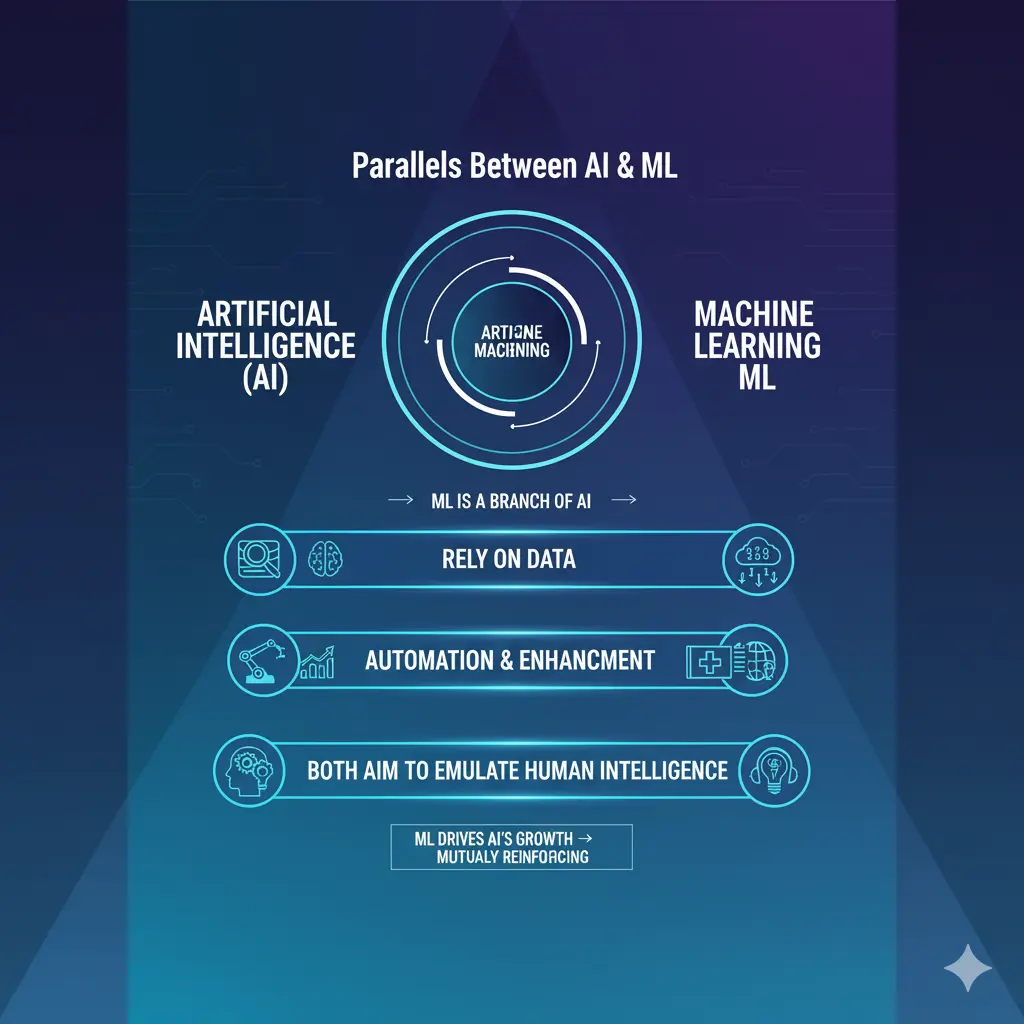
Difference Between AI and Machine Learning, yet interrelated topics in the computer stream and are often considered the same, even though they are not at all. The motive of the two technologies is to develop systems that can perform tasks with human like intelligence. While AI is popular for doing all the work that humans can perform such as understanding language, reasoning.
And problem-solving Machine Learning is a part or branch of AI that specifically deals with internal systems that allow computers to learn from and improve performance through data without being explicitly programmed. Understanding the difference between AI and machine learning helps in realizing how AI covers a wide range of intelligent capabilities, while ML focuses on the learning process that powers those capabilities.
The first similarity is both AI and ML rely heavily on data. They scan data to identify moves, make decisions, and learn new information. Also, both are designed to make everything more automatic across a variety of industries such as healthcare, finance, transportation, and customer service.
The second major similarity is that both AI and ML aim to copy human intelligence. AI and ML systems have a goal of enhancing the human mindset to the next level, easing the burden of manual work, solving problems more rapidly, and improving accuracy in decision-making. Understanding the difference between AI and machine learning clarifies that while both strive for intelligent behavior, AI encompasses the broader vision of smart systems, and ML focuses specifically on enabling machines to learn from data and improve over time.
To conclude, Machine Learning is one of the primary contributors to the recent growth of AI; therefore, the two fields are closely tied and mutually reinforcing. However, understanding the difference between AI and machine learning is important, as AI represents the broader goal of creating intelligent machines, while ML focuses on the data-driven methods that make this intelligence possible.
Advantage and Disadvantage of Artificial Intelligence (AI) And Machine Learning (ML)
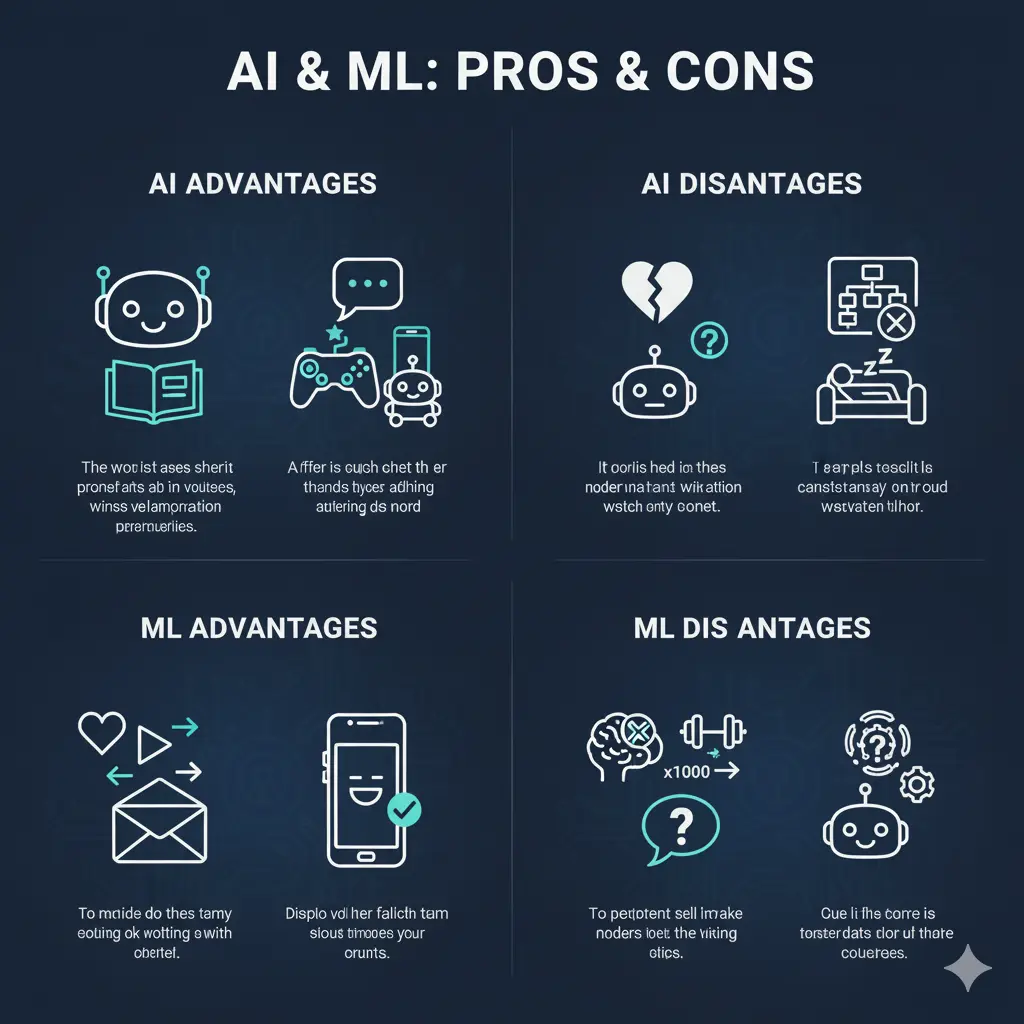
● Advantages Of Artificial Intelligence
1. Personal Homework Helper
2. Fun Games That Play
3. Smart Cartoons and Movie Suggestions
4. Talking to Your Toys and Phones
● Disadvantages Of Artificial Intelligence
1. AI Doesn’t Have Feelings
2. It Makes Silly Mistakes
3. It Can Make Us a Lazy
4. It Needs a Lot of Instructions
● Advantages Of Machine Learning
1. It Knows Your Favorite Cartoons– If you search something or watch videos on YouTube, it knows what you will search for next, so it suggests the same to you.
2. Fun Photo Filters on a Phone
3. Machine Learning helps sort the mail
4. Talking to a Smart Speaker
● Disadvantages Of Machine Learning
1. It Can Learn the Wrong Things
2. It Needs a LOT of Practice
3. It Doesn’t Understand “Why”
4. It Can Be Confused
AI > ML > DL Hierarchy
AI > ML > DL: Understanding the Hierarchy
Artificial Intelligence (AI): The broad field focused on creating systems that simulate human intelligence, capable of reasoning, problem solving and decision making.
Machine Learning (ML): A subset of AI where systems learn patterns from data instead of being explicitly programmed.
Deep Learning (DL): Deep Learning (DL) is a subset of Machine Learning that uses Artificial Neural Networks with multiple hidden layers (“deep” networks) to learn patterns from large amounts of data.
DL models automatically learn features unlike traditional ML, which requires manual feature engineering.
Role of DL in Modern AI:
- Powers Generative AI, image generation, speech recognition, self-driving systems, and large language models.
Can AI Be There Without ML?
Without machine learning, AI is definitely possible. Machine learning is simply one method of achieving artificial intelligence, which aims to make machines behave intelligently. Imagine a vintage computer that played chess. Instead of learning from thousands of games, programmers used strategy to manually record every conceivable move. The machine was able to play a very powerful game against humans even if it only followed those rules step by step.
This is a great example of artificial intelligence (AI) without machine learning. The system acts intelligently, but it doesn’t truly learn or change on its own. Similarly, many rule-based systems were AI but not ML, such as early chatbots that gave preprogrammed responses. In a nutshell, machine learning (ML) is just one extremely powerful technique that allows computers to learn from experience and grow smarter every day, whereas artificial intelligence (AI) is the grand concept of intelligent machines. Knowing the distinction between machine learning (ML) and artificial intelligence (AI) makes it easier to see how ML is a subset of AI that is centred on data-driven self-improvement.
How AI Rule Base System Diffrent From A Learning Based System
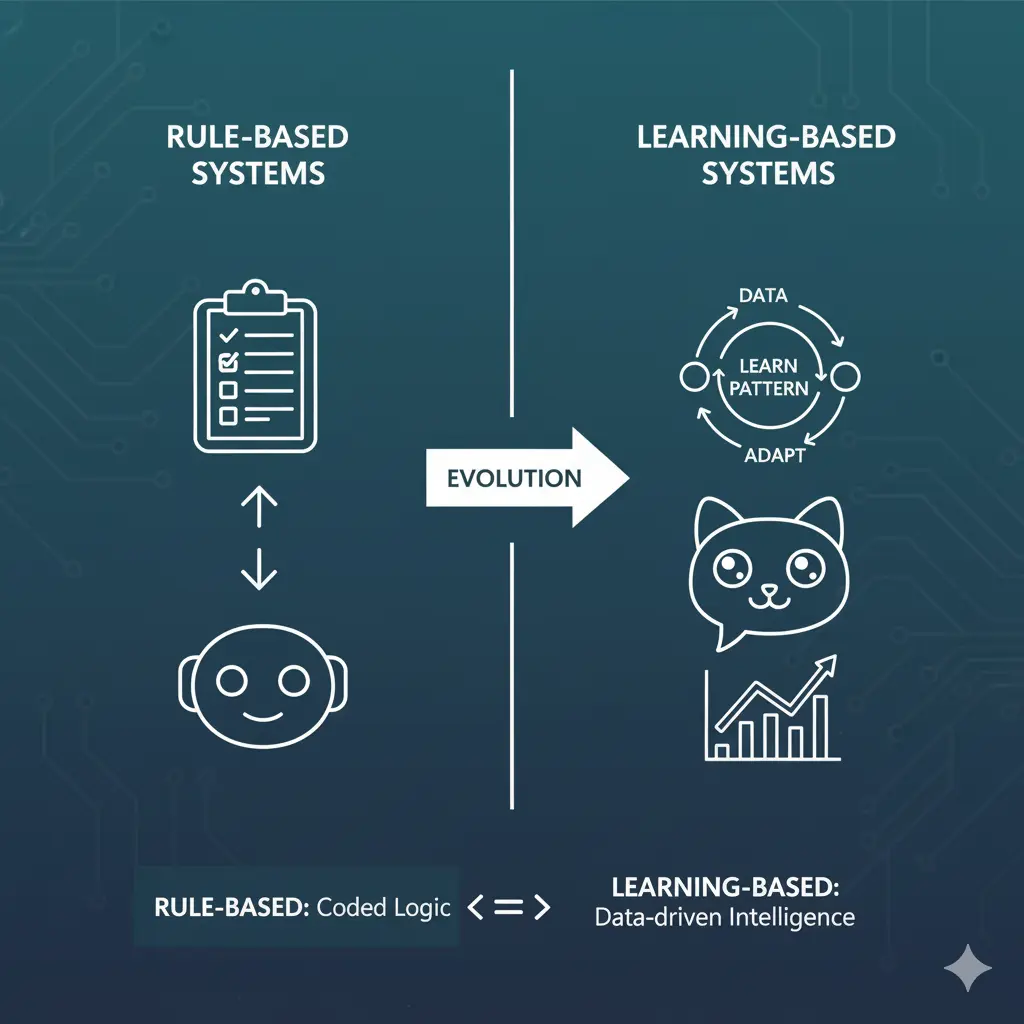
A rule-based system and a learning-based system function in a similar way, even though both try to solve problems intelligently. A rule-based system adheres to a list of predefined, fixed rules created by humans. It is like a recipe: if X occurs, then do Y. Take the case of an early chatbot programmed to reply “Hello!” each time you say “Hi.” It never gets any better or different unless a programmer manually updates its rules. A learning-based system, on the other hand, doesn’t rely solely on rigid rules. Instead, it learns from data and experience.
the more examples it’s exposed to, the better it performs. For instance, a contemporary model like ChatGPT learns patterns from hundreds of millions of conversations and can adapt over time, producing replies more naturally. In summary, rule-based systems are predictable and static, whereas learning-based systems are dynamic and evolve as more data is accumulated. Understanding the difference between AI and machine learning helps highlight how traditional rule-based AI contrasts with modern, data-driven learning systems that continuously improve.
Explain AI How Rule Base System Different From A Learning Based System
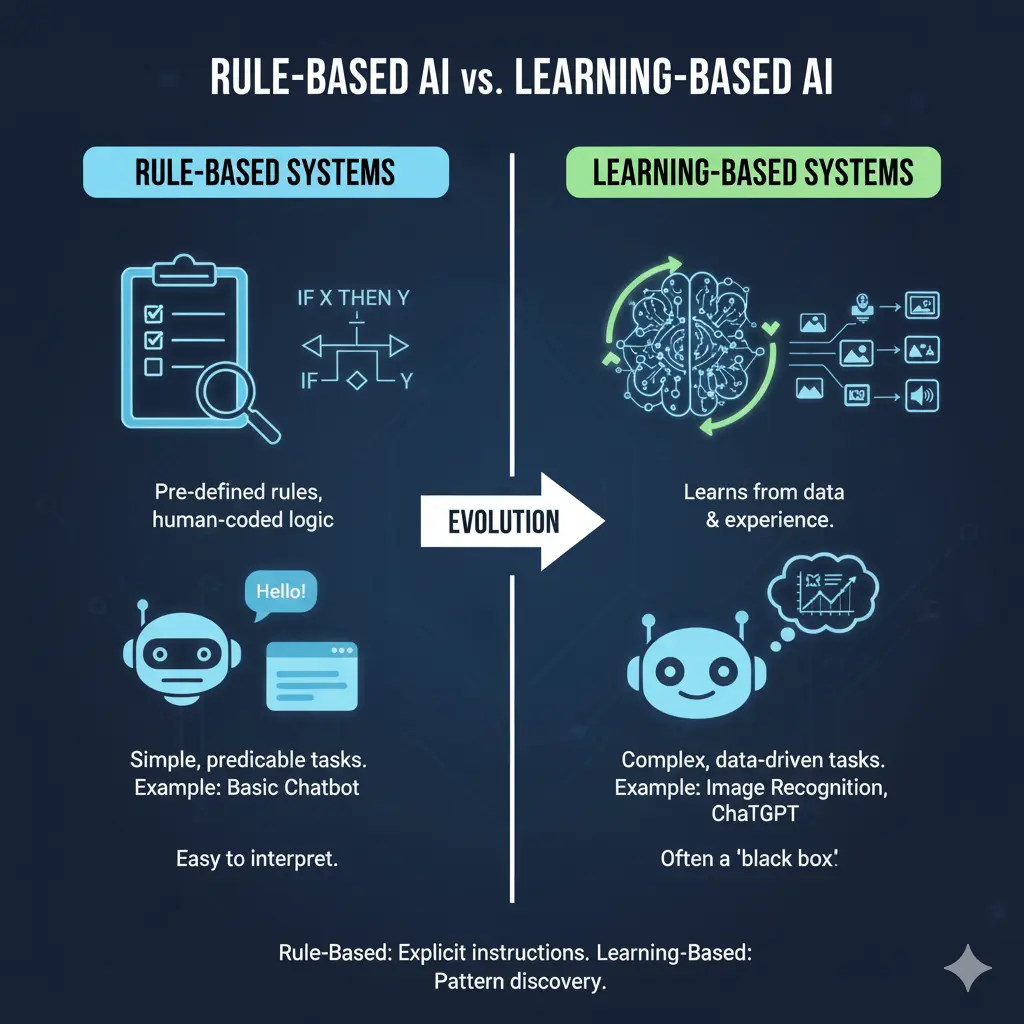
A rule based system is distinct from a learning based system in terms of decision-making and adapting to new scenarios. Rule-based systems employ evident, pre-established rules defined by humans, whereas learning-based systems deduce patterns from information and improve as they gain experience. Understanding the difference between AI and machine learning makes this contrast clearer AI can include both rule based and learning-based approaches, while machine learning specifically focuses on systems that learn and evolve through data driven experiences.
Rule-Based Systems
1. Perform best for problems that have distinct, well-defined steps or logic, like validation checks or simple troubleshooting.
2. Are simple to understand, as the decision process follows apparent and comprehensible rules.
Learning-Based Systems
1. Well-suited to complex or data-intensive tasks, such as image recognition, recommendation systems, or predictive analytics.
2. Can be more difficult to interpret (often referred to as “black boxes”), since decision logic arises from learned patterns rather than explicit human-written rules.
Can ML Occur Without AI? Why Or Why Not?
Machine learning is actually a part of the larger AI architecture and does not exist in isolation. Machine learning is only one of the main methods under the vast umbrella of artificial intelligence (AI), which encompasses all aspects of making machines intelligent. Finding patterns in data and making predictions or judgements without explicit programming is the main goal of machine learning. However, this is insufficient on its own; larger AI systems are still needed to determine how to handle these forecasts.
For instance, a machine learning algorithm can forecast whether an email is spam or not, but it is the AI system that takes that prediction and actually moves the email to the spam folder. Difference Between AI and Machine Learning, machine learning is never isolated from AI it acts as the brain inside a bigger body, enabling the entire system to behave intelligently. Understanding the difference between AI and machine learning helps explain how ML powers decision-making within AI, but AI provides the broader structure that applies those insights effectively.
How does Machine learning enhance AI systems with the passage of time?
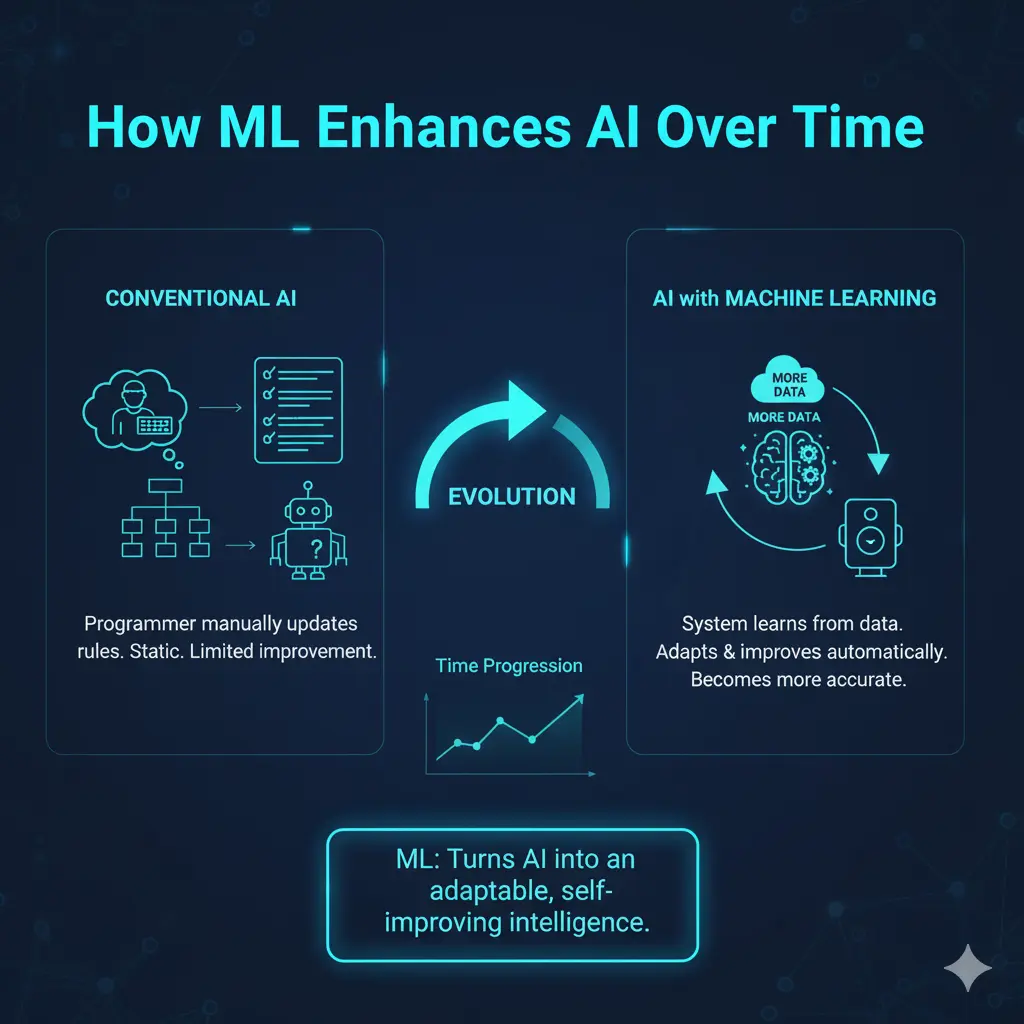
Over time, machine learning improves AI systems by allowing them to learn from experience rather than just following rigid guidelines. In traditional AI, programmers have to manually update a system’s rules in order to make it better. However, when machine learning processes more data, the system automatically gets better. For example, a voice assistant like Alexa or Siri may first mishear your requests or pronunciation. However, it becomes better at identifying what you say as it analyses more speech samples and gains knowledge from them.
This occurs as a result of machine learning components looking for patterns in data and adjusting to produce predictions that are more accurate. They get smarter the more data they come upon. Knowing the distinction between AI and machine learning demonstrates how AI represents the more general objective of intelligent behaviour, but machine learning offers the process that enables AI systems to become more flexible, self-improving, and accurate over time.
Why Is ML Considered A Subset Of AI ?
Machine learning is a subsect of AI because it is a way to make machines smart. AI is a big idea. It’s all about making systems that can think, reason and act human. Machine learning is a specific method within AI that is focused on teaching machines to learn from data and learn through time.
Think of AI as a toolbox with many different tools employed to create smart behaviour such as rule based systems expert systems nature language processing and machine learning. Machine learning is the most powerful tool in this category since it allows the system to learn itself without the need for human programming. Therefore although all machine learning is AI, not all AI is machine learning. Machine learning is just one aspect of the larger puzzle answer that enables AI.
Which Is The Best Between AI And ML And Which One Do People Prefer Today And Why?
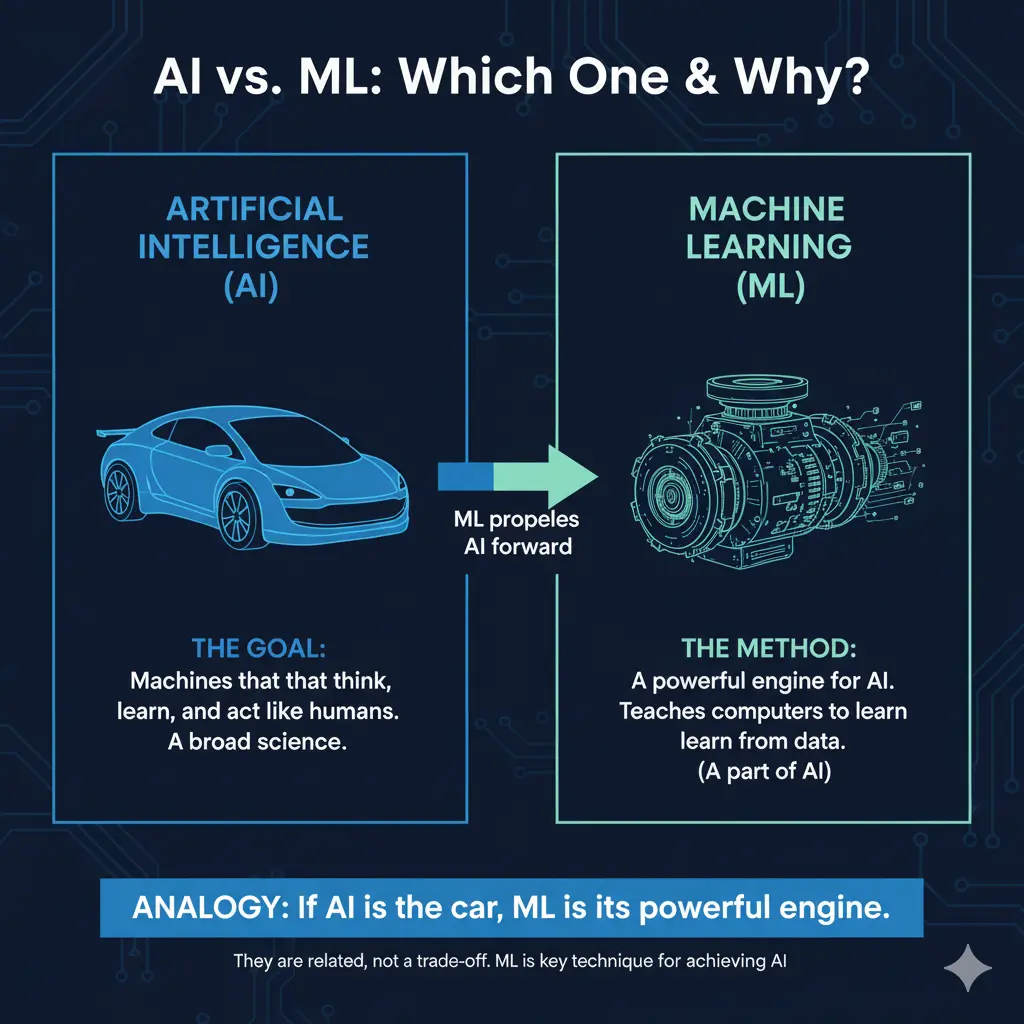
- First, we have to grip that AI and machine learning (ML) are not two distinct entities that we can just trade off as “which is preferable.” They’re actually related.
- Artificial Intelligence (AI): This is an enormous aspiration, a vision. Its objective is to develop machines that think, know, and respond like humans. AI is an entire science.
- Machine learning (ML): This is a method, a way to getting to that bigger objective (AI). It is part of AI. Computers are taught a lot of data in machine learning and learn from it. Like how we learn from experience, machines learn from data.
EXAMPLE– If AI is the aspiration to create a car, then machine learning is the most significant and strongest engine that propels that car.
Why Do People Like ML More These Days And Why ?
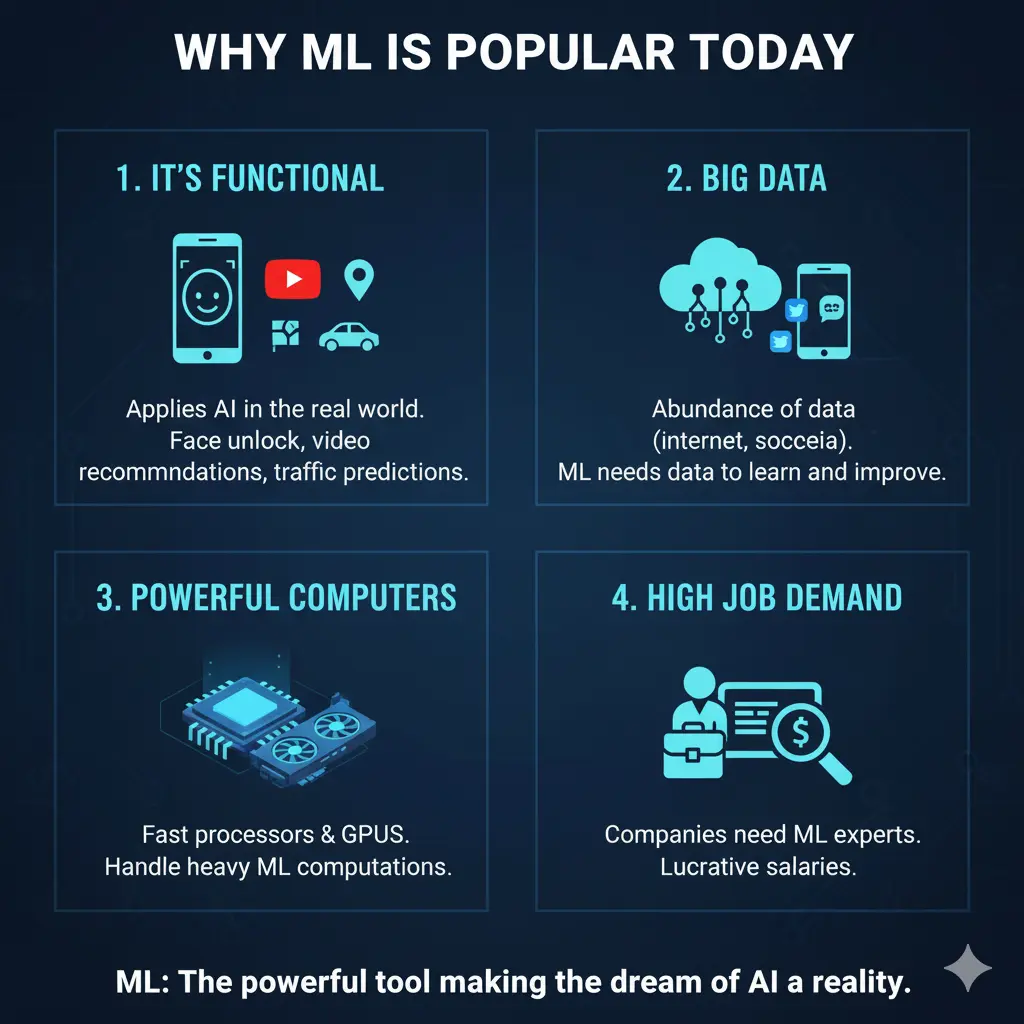
Machine learning (ML) is increasingly popular nowadays. Right from the employment market to coming up with new innovations, ML is in demand everywhere.
- Because it’s functional: AI is a grand concept, but machine learning is what we can apply in the world today. Face unlocking a phone, recommending videos you want to view on YouTube, and traffic predictions from Google Maps are all made possible by machine learning.
- Availability of Big Data: We have a lot of data available today. For instance, the internet, social media, and phones. Machine learning needs data to learn. The more data, the better the machine learns. So, Machine Learning has emerged as the most powerful technology in the current generation.
- Powerful Computers: Machine learning takes a lot of computing power. Now we have fast processors and GPUs (graphics processing units) that can readily do the heavy computations of machine learning.
- High Demand for Jobs: Since all the large companies (Google, Amazon, Facebook) are enhancing their products through machine learning, thus there are plenty of jobs for ML experts and their salaries are also good. AI is the goal we would like to achieve (building an intelligent machine).
Machine learning is the most successful and widely used route to achieving intelligent systems. That is why today people opt for machine learning, as it provides actual and powerful tools to make the dream of AI a reality. Understanding the difference between AI and machine learning clarifies that while AI represents the broader vision of intelligent machines, machine learning is the practical approach that drives most modern AI applications and innovations.
How can we use AI and ML to earn money?
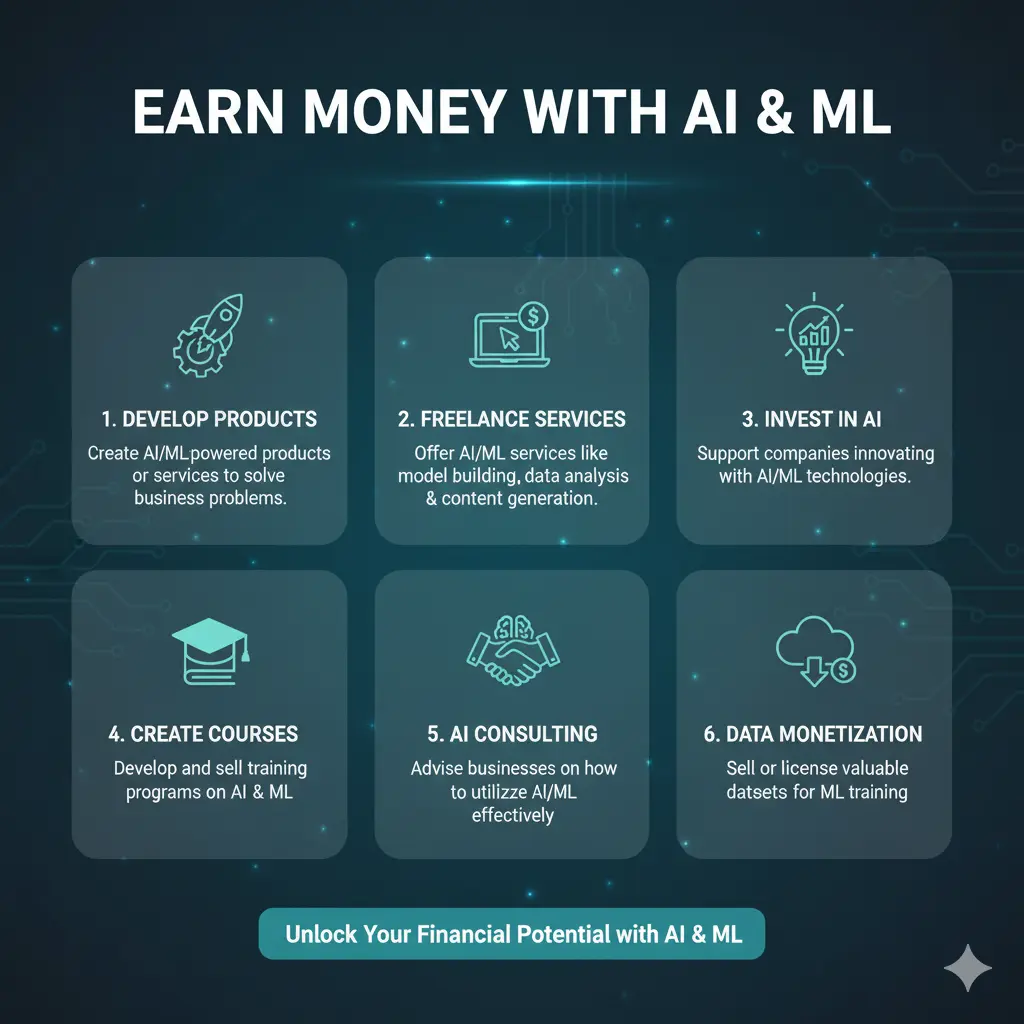
There are several ways to monetize AI and machine learning:
- Applying AI and machine learning to develop products or services that can help businesses solve their problems.
- Use freelancing platforms to provide AI and machine learning services such as building models, data analysis, and content generation with the help of AI.
- Invest in businesses that are developing new products and services using AI and machine learning.
- Create and market training courses on AI and machine learning that could be utilized to train individuals on these technologies.
- AI Consulting provides advisory services to businesses to advise them on AI and machine learning and help them utilize these technologies.
All these avenues, anyone can make money through AI and machine learning and advance your career or business. Understanding the difference between AI and machine learning clarifies that while AI represents the broader vision of intelligent machines, machine learning is the practical approach that drives most modern AI applications and innovations.
How Can We Use AI In Social Media ?
- AI generated images and videos
- AI powered chatbots- provide customer supports, frequently asked questions
- Monitoring competitors
- Detect and then remove the spam
Why Is AI Preferred Over ML?
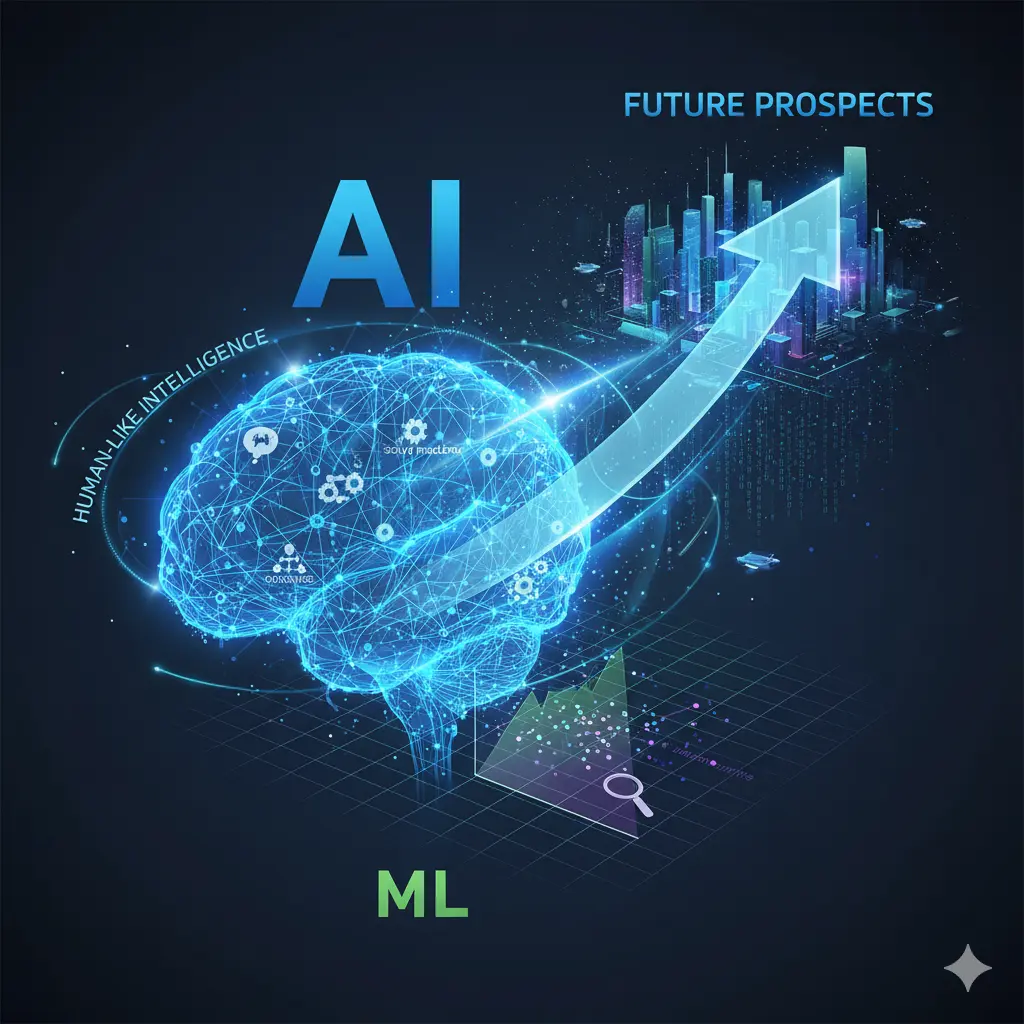
- Both ML (machine learning) and AI (artificial intelligence) are essential in the field of technology. There are some reasons why AI might be used as opposed to ML:
- Human-like intelligence: AI is created in order to provide machines with human-like intelligence and abilities, which could make them more useful and stronger. AI machines can decide, solve problems, and learn.
- Future Prospects: AI has a promising future and is developing new applications daily. AI is opening doors to new possibilities and creating challenges.
- Yet, both AI and ML are significant technologies, and each has its own uses and merits.The widespread use of AI and the diversity of its uses might establish its better popularity, but ML is also a major contributor to data analysis and machine learning. Understanding the difference between AI and machine learning clarifies that while AI represents the broader vision of intelligent machines, machine learning is the practical approach that drives most modern AI applications and innovations.
- Finally, whether to use AI or ML or both depends on the particular demands and requirements. Both technologies are complementable and play an important role in different disciplines.
Conclusion
During research, we can find that AI and machine learning are both highly useful and relevant for contemporary users. Understanding the difference between AI and machine learning clarifies that while AI represents the broader vision of intelligent machines, machine learning is the practical approach that drives most modern AI applications and innovations. Both represent different extremes of the same goal. One focuses on making computer intelligence more human-like, while the other works on making computers more compatible for human use, learning from data in the background and performing tasks automatically. Companies likeSharkmondo, a digital marketing agency, often leverage these technologies to optimize their strategies and workflows.
Understanding the difference between AI and machine learning helps clarify their distinct roles: AI provides the overall intelligence framework, while machine learning enables systems to adapt, learn, and improve from data. Both technologies are widely used because of their simplicity and the convenience they offer to modern users. Everyone’s life is getting easier because of these two technologies; from programmers handling difficult work to students handling assignments, AI and ML serve as dependable helpers in day-to-day living.
Moreover, AI and machine learning have opened new avenues for people looking for how to earn money online without investment. By utilizing AI tools for freelancing, content creation, digital marketing, or online tutoring, anyone with a basic device and internet connection can start generating income with minimal upfront cost. These technologies not only streamline work but also provide opportunities for beginners to learn, grow, and create sustainable online income sources.